RNF216 Polyclonal Antibody, Invitrogen™
Manufacturer: Thermo Scientific
Select a Size
| Pack Size | SKU | Availability | Price |
|---|---|---|---|
| Each of 1 | PIPA582649-Each-of-1 | In Stock | ₹ 48,905.50 |
PIPA582649 - Each of 1
In Stock
Quantity
1
Base Price: ₹ 48,905.50
GST (18%): ₹ 8,802.99
Total Price: ₹ 57,708.49
Antigen
RNF216
Classification
Polyclonal
Conjugate
Unconjugated
Gene
RNF216
Gene Alias
2810055G22Rik; AI647468; AU019462; C86502; CAHH; E3 ubiquitin ligase; E3 ubiquitin-protein ligase RNF216; F830018F18Rik; RGD1565135; RING finger protein 216; RING-type E3 ubiquitin transferase RNF216; RNF216; Triad domain-containing protein 3; TRIAD3; triad3a; U7I1; UBCE7IP1; UbcM4-interacting protein 83; ubiquitin-conjugating enzyme 7-interacting protein 1; Uip83; Zin; zinc finger protein inhibiting NF-kappa-B
Host Species
Rabbit
Purification Method
Anitgen affinity chromatography, Antigen affinity chromatography
Regulatory Status
RUO
Gene ID (Entrez)
54476
Content And Storage
Store at 4°C short term. For long term storage, store at -20°C, avoiding freeze/thaw cycles.
Form
Liquid
Applications
Immunocytochemistry, Immunohistochemistry
Concentration
0.05 mg/mL
Formulation
PBS with 40% glycerol and 0.02% sodium azide; pH 7.2
Gene Accession No.
Q9NWF9
Gene Symbols
RNF216
Immunogen
Recombinant protein corresponding to Human RNF216
Quantity
100 μL
Primary or Secondary
Primary
Target Species
Human
Product Type
Antibody
Isotype
IgG
Related Products
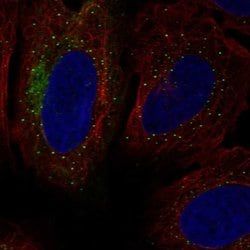
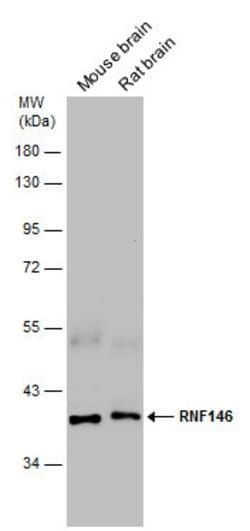
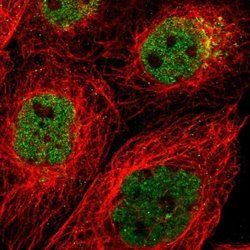

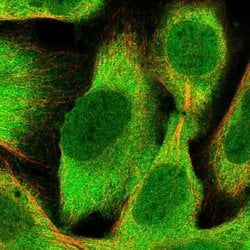

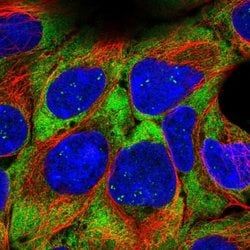
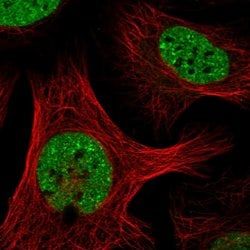
Description
- Immunogen sequence: VKETEARFPD VANGFIEEII HFKNYYDLNV LCNFLLENPD YPKREDRIII NPSSSLLASQ DETKLPKIDF FDYSKLTPLD Activation of NF-κB as a result of Toll-like receptor (TLR) and IL-1 receptor signaling is a major component of innate immune responses
- Signals from these receptors are relayed by a number of adapter molecules such as TRIF, TIRAP, and MyD88
- Several regulatory mechanisms exist to control TLR signal transduction, including the inhibition of TLR expression and signaling by molecules such as ST2 and SIGIRR
- Another mechanism is by the ubi-quitinization of selected TLRs by TRIAD3A, an E3 ubiquitin-protein ligase
- TRIAD3A is a RING finger protein that can bind to TLR4 and TLR9, and to a lesser extent TLR3 and TLR5, catalyzing the ubiquitization of these molecules
- Overexpression of TRIAD3A promoted the nearly complete degradation of TLR4 and TLR9; this reduction was reflected in the decreased signal-specific activation by ligands specific for these TLRs
- Conversely, depletion of TRIAD3A resulted in enhanced TLR activation.