SRSF5 Polyclonal Antibody, Invitrogen™
Manufacturer: Thermo Scientific
Select a Size
| Pack Size | SKU | Availability | Price |
|---|---|---|---|
| Each of 1 | PIPA584300-Each-of-1 | In Stock | ₹ 48,905.50 |
PIPA584300 - Each of 1
In Stock
Quantity
1
Base Price: ₹ 48,905.50
GST (18%): ₹ 8,802.99
Total Price: ₹ 57,708.49
Antigen
SRSF5
Classification
Polyclonal
Conjugate
Unconjugated
Gene
SRSF5
Gene Alias
Cl-4; Delayed-early protein HRS; Hrs; Insulin-induced growth response protein CL-4; pre-mRNA-splicing factor SRP40; serine and arginine rich splicing factor 5; serine/arginine-rich splicing factor 5; SFRS5; splicing factor arginine/serine-rich 5 (SRp40 HRS); splicing factor, arginine/serine-rich 5; splicing factor, arginine/serine-rich 5 (SRp40, HRS); SR splicing factor 5; SRp40; Srsf5
Host Species
Rabbit
Purification Method
Anitgen affinity chromatography, Antigen affinity chromatography
Regulatory Status
RUO
Gene ID (Entrez)
6430
Content And Storage
Store at 4°C short term. For long term storage, store at -20°C, avoiding freeze/thaw cycles.
Form
Liquid
Applications
Immunocytochemistry
Concentration
0.05 mg/mL
Formulation
PBS with 40% glycerol and 0.02% sodium azide; pH 7.2
Gene Accession No.
Q13243
Gene Symbols
SRSF5
Immunogen
Recombinant protein corresponding to Human SRSF5
Quantity
100 μL
Primary or Secondary
Primary
Target Species
Human
Product Type
Antibody
Isotype
IgG
Related Products
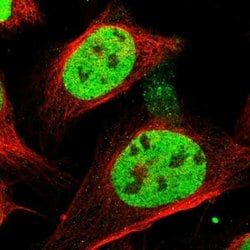
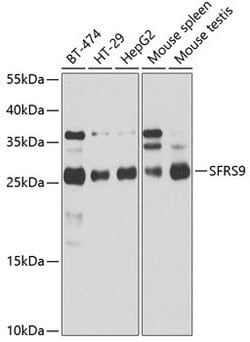
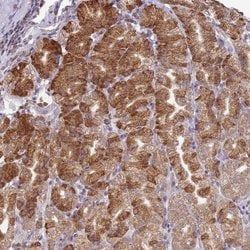
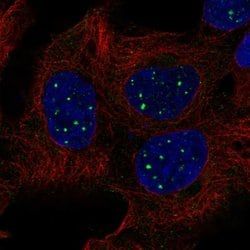

Description
- Immunogen sequence: KSRSVSRSPV PEKSQKRGSS SRSKSPA SR proteins are a highly conserved family of arginine/serine-rich, spliceosome-associated phosphoproteins essential for metazoan pre-mRNA splicing
- SR proteins act early in splicing by promoting splice site recognition and spliceosome assembly
- SR proteins also play a regulatory role because they can determine alternative splice site usage in vivo and in vitro
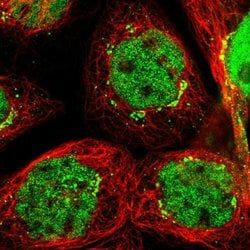
- SR proteins appear to be recruited from nuclear 'speckles', in which they are concentrated to sites of transcription in order to spatially coordinate transcription and pre-mRNA splicing within the cell nucleus.