TAS2R38 Polyclonal Antibody, Invitrogen™
Manufacturer: Thermo Scientific
Select a Size
| Pack Size | SKU | Availability | Price |
|---|---|---|---|
| Each of 1 | PIPA599928-Each-of-1 | In Stock | ₹ 45,968.50 |
PIPA599928 - Each of 1
In Stock
Quantity
1
Base Price: ₹ 45,968.50
GST (18%): ₹ 8,274.33
Total Price: ₹ 54,242.83
Antigen
TAS2R38
Classification
Polyclonal
Conjugate
Unconjugated
Gene
TAS2R38
Gene Alias
mt2r31; PTC; PTC bitter taste receptor; RGD:1560649}; T2R138; T2R26; T2r31; T2r38; T2r38 {ECO:0000312; T2R61; Tas2r138; Tas2r26; TAS2R38; taste 2 receptor member 38; taste receptor type 2 member 26; Taste receptor type 2 member 38; taste receptor type 2 member 61; taste receptor, type 2, member 138; taste receptor, type 2, member 38
Host Species
Rabbit
Purification Method
Affinity chromatography
Regulatory Status
RUO
Gene ID (Entrez)
387513, 500091, 5726
Content And Storage
-20°C
Form
Liquid
Applications
Immunohistochemistry (Paraffin), Western Blot
Concentration
1 mg/mL
Formulation
PBS with 50% glycerol and 0.02% sodium azide; pH 7.4
Gene Accession No.
P59533, Q4VHE7, Q7TQA6
Gene Symbols
Tas2r138, TAS2R38
Immunogen
A synthesized peptide derived from human TAS2R38(Accession P59533), corresponding to amino acid residues L210-S260.
Quantity
100 μL
Primary or Secondary
Primary
Target Species
Human, Mouse, Rat
Product Type
Antibody
Isotype
IgG
Related Products



Description
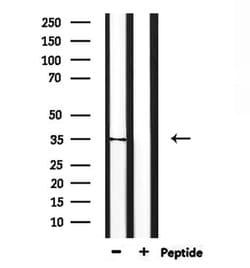
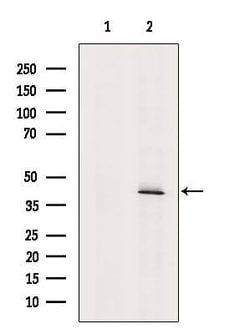
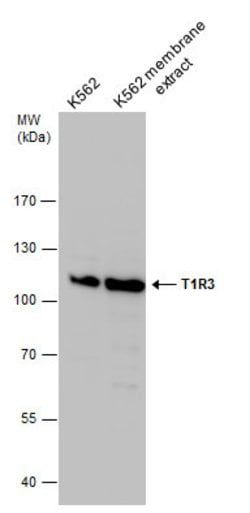
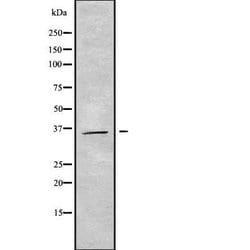
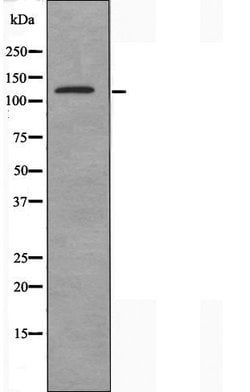
- Antibody detects endogenous levels of total TAS2R38
- Receptor that may play a role in the perception of bitterness and is gustducin-linked
- May play a role in sensing the chemical composition of the gastrointestinal content
- The activity of this receptor may stimulate alpha gustducin, mediate PLC-beta-2 activation and lead to the gating of TRPM5
- Expressed in subsets of taste receptor cells of the tongue and exclusively in gustducin-positive cells
- Variations in TAS2R38 are associated with the ability to taste phenylthiocarbamide (PTC tasting); also called thiourea tasting
- The ability to taste the substance PTC and a number of related substances is genetically controlled
- Genetic studies have demonstrated complex inheritance for this trait
- For some people (and some chimpanzees also), the chemical PTC tastes very bitter
- For others, it is tasteless
- Actually, substantial variation in taste sensitivity exists in human
- Five haplotypes arising from three coding SNPs in the TAS2R38 gene are associated with distinct phenotypes of PTC taste sensitivity.