391522
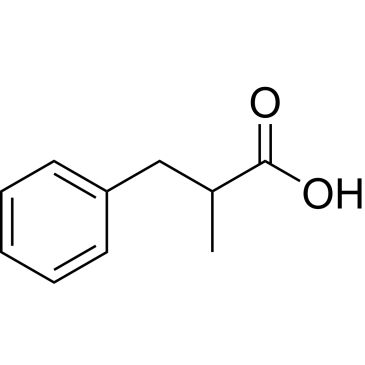
α-Methylhydrocinnamic acid
98%
Manufacturer: Sigma Aldrich
CAS Number: 1009-67-2
Select a Size
| Pack Size | SKU | Availability | Price |
|---|---|---|---|
| 5 G | 391522-5-G | In Stock | ₹ 9,990.00 |
391522 - 5 G
In Stock
Quantity
1
Base Price: ₹ 9,990.00
GST (18%): ₹ 1,798.20
Total Price: ₹ 11,788.20
Assay
98%
form
solid
bp
167-168 °C/23 mmHg (lit.)
mp
39-41 °C (lit.)
density
1.065 g/mL at 25 °C (lit.)
SMILES string
CC(Cc1ccccc1)C(O)=O
InChI
1S/C10H12O2/c1-8(10(11)12)7-9-5-3-2-4-6-9/h2-6,8H,7H2,1H3,(H,11,12)
InChI key
MCIIDRLDHRQKPH-UHFFFAOYSA-N
Other Options
| Image | Product Name | Manufacturer | Price Range | |
|---|---|---|---|---|
 | Sigma Aldrich Fine Chemicals Biosciences alpha-Methylhydrocinnamic acid 98% | 1009-67-2 | MFCD00192301 | 5G | Sigma Aldrich Fine Chemicals Biosciences | ₹ 28,237.92 | |
 | 2-Methyl-3-phenylpropanoic acid | ChemScene | ₹ 2,581.00 - ₹ 1,06,978.00 |
Description
- General description: α-Methylhydrocinnamic acid (2-methyl-3-phenylpropionic acid, 2-benzylpropionic acid) is a cinnamic acid derivative. Its synthesis by the asymmetric hydrogenation of α-methylcinnamic acid has been reported.[1] α-Methylhydrocinnamic acid, a short chain fatty acid derivative (SCFAD), has been reported to correct the cystic fibrosis transmembrane conductance regulator (ΔF508-CFTR) defect.[2] Conformational studies of 2-methyl-3-phenylpropionic acid has been investigated by NMR spectroscopy.[3] The enantiomers of 2-benzylpropionic acid has been reported to be synthesized using a lipase-catalyzed resolution.[4] (S) (+)-2-methyl-3-phenylpropionic acid participates in the synthesis of optically active (R)-5-methyl-6-phenylhexanoyl azide.[5] L-2-Methyl-3.phenylpropionic acid has been reported to be an inhibitor of carboxypeptidase A.[6] Polymer-supported “Evans” oxazolidinone mediated solid phase asymmetric has been employed in the synthesis of (S)-2-methyl-3-phenylpropionic acid.[7]
- Application: α-Methylhydrocinnamic acid is suitable for use in the comparative study to investigate the γ-globin inducibility of short-chain fatty acid derivatives (SCFADs) in mice.[8] It may be used as a histone deacetylase (HDAC) inhibitor in the comparative study to investigate the EGFP-induction potency of a number of HDAC inhibitors.[9] It may be used in the study to investigate the selectivity of the sensor based on imprinted poly(o-phenylenediamine) (iPoPD).[10]
SAFETY INFORMATION
Pictograms
Signal Word
Warning
Hazard Statements
Precautionary Statements
P261 - P264 - P271 - P280 - P302 + P352 - P305 + P351 + P338
Hazard Classifications
Eye Irrit. 2 - Skin Irrit. 2 - STOT SE 3
Target Organs
Respiratory system
WGK
WGK 3
Flash Point(F)
closed cup
Flash Point(C)
closed cup
Personal Protective Equipment
dust mask type N95 (US), Eyeshields, Gloves