B1378
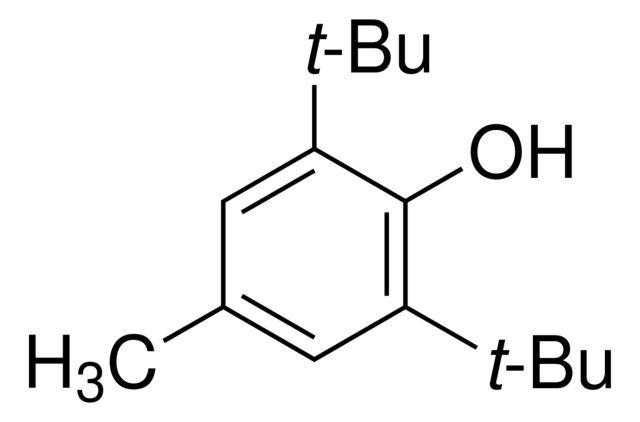
2,6-Di-tert-butyl-4-methylphenol
≥99.0% (GC), powder
Manufacturer: Sigma Aldrich
CAS Number: 128-37-0
Synonym(S): 2,6-Di-tert-butyl-p-cresol, BHT, Butylated hydroxytoluene, Butylhydroxytoluene, DBPC
Select a Size
| Pack Size | SKU | Availability | Price |
|---|---|---|---|
| 100 G | B1378-100-G | In Stock | ₹ 2,570.00 |
| 500 G | B1378-500-G | In Stock | ₹ 4,189.28 |
| 1 KG | B1378-1-KG | In Stock | ₹ 6,590.00 |
B1378 - 100 G
In Stock
Quantity
1
Base Price: ₹ 2,570.00
GST (18%): ₹ 462.60
Total Price: ₹ 3,032.60
vapor density
7.6 (vs air)
Quality Level
200
vapor pressure
<0.01 mmHg ( 20 °C)
Assay
≥99.0% (GC)
form
powder
autoignition temp.
878 °F
bp
265 °C (lit.)
mp
69-73 °C (lit.)
solubility
ethanol: 100 mg/mLvegetable oils: soluble
SMILES string
Cc1cc(c(O)c(c1)C(C)(C)C)C(C)(C)C
Other Options
Related Products
Description
- Application: Thermal decomposition characteristics of BHT and its peroxide (BHTOOH): BHT is highlighted for its excellent antioxidant properties, which degrade into BHTOOH under specific conditions (S Dai, et al., 2024). Relaxation mechanisms in low-stress polymer networks: BHT is utilized in polymer networks to assess its effects on the mechanical properties and durability of dental composites (SH Lewis, et al., 2024). Compatibility and safety of labels for pharmaceutical packaging: The study found BHT in labels, indicating its widespread use in pharmaceutical packaging due to its stabilizing properties (C Fu, et al., 2023).
- Biochem/physiol Actions: Butylated hydroxytoluene (BHT) is a phenolic antioxidant. It has been shown to inhibit lipid peroxidation. It causes lung injury and promotes tumors in mice, but this may be due to a metabolite of BHT, 6-tert-butyl-2-[2′-(2′-hydroxymethyl)-propyl]-4-methylphenol. Metabolites of BHT have also been reported to induce DNA strand breaks and internucleosomal DNA fragmentation (a characteristic of apoptosis) in cultured cells. In rats, a single intraperitoneal injection of BHT (60 mg/kg body mass) results in a significant increase in nuclear DNA methyl transferase activity in the liver, kidneys, heart, spleen, brain and lungs. Incubation of alveolar macrophages with BHT significantly reduced the level of TNF-α which may explain the mechanism by which this antioxidant reduces inflammation. Preincubation of aspirin-treated platelets with BHT inhibits the secretion, aggregation, and protein phosphorylation induced by protein kinase C activators. BHT was also found to inhibit the initiation of hepatocarcinogenesis by aflatoxin B1.
SAFETY INFORMATION
Pictograms
Signal Word
Warning
Hazard Statements
Precautionary Statements
Hazard Classifications
Aquatic Acute 1 - Aquatic Chronic 1
WGK
WGK 2
Flash Point(F)
open cup
Flash Point(C)
open cup
Personal Protective Equipment
dust mask type N95 (US), Eyeshields, Gloves