928364
XPhos ChemBeads
Manufacturer: Sigma Aldrich
CAS Number: 564483-18-7
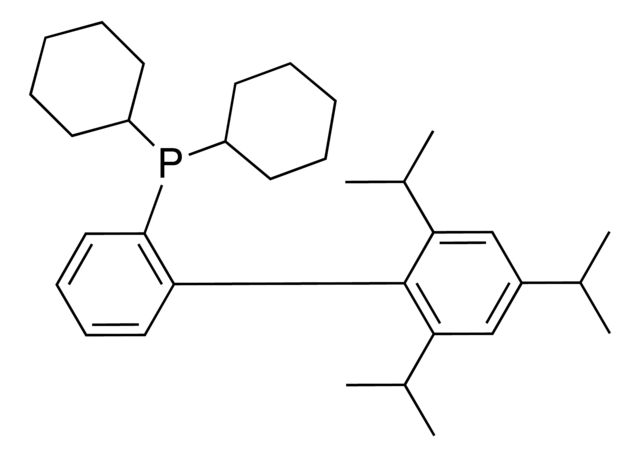
Synonym(S): 2-Dicyclohexylphosphino-2’,4’,6’-triisopropylbiphenyl
Select a Size
| Pack Size | SKU | Availability | Price |
|---|---|---|---|
| 1 G | 928364-1-G | In Stock | ₹ 27,679.53 |
928364 - 1 G
In Stock
Quantity
1
Base Price: ₹ 27,679.53
GST (18%): ₹ 4,982.315
Total Price: ₹ 32,661.845
Assay
~6 wt.% loading of catalyst
Quality Level
100
form
solid
reaction suitability
reagent type: catalystreaction type: Cross Couplings
extent of labeling
~6 wt. % loading of catalyst
InChI
1S/C33H49P/c1-23(2)26-21-30(24(3)4)33(31(22-26)25(5)6)29-19-13-14-20-32(29)34(27-15-9-7-10-16-27)28-17-11-8-12-18-28/h13-14,19-25,27-28H,7-12,15-18H2,1-6H3
InChI key
UGOMMVLRQDMAQQ-UHFFFAOYSA-N
Other Options
| Image | Product Name | Manufacturer | Price Range | |
|---|---|---|---|---|
Strem, An Ascensus Company CAS# 564483-18-7. 2g. 2-(Dicyclohexylphosphino)-2',4',6'-tri-i-propyl-1,1'-biphenyl, min. 98% XPhos. MFCD04117682 | -- | ₹ 5,927.40 | ||
Sigma Aldrich Fine Chemicals Biosciences XPhos 98% | 564483-18-7 | MFCD04117682 | 25G | -- | ₹ 65,532.48 | ||
Strem, An Ascensus Company CAS# 564483-18-7. 100g. 2-(Dicyclohexylphosphino)-2',4',6'-tri-i-propyl-1,1'-biphenyl, min. 98% XPhos. MFCD04117682 | -- | ₹ 2,02,332.60 | ||
Sigma Aldrich Fine Chemicals Biosciences XPhos 98% | 564483-18-7 | MFCD04117682 | 100G | -- | ₹ 2,45,733.45 | ||
Sigma Aldrich Fine Chemicals Biosciences XPhos 97, 564483-18-7, MFCD04117682 | -- | ₹ 19,188.40 | ||
Sigma Aldrich Fine Chemicals Biosciences XPhos | 564483-18-7 | MFCD04117682 | 1g | -- | ₹ 10,401.43 | ||
XPhos | -- | ₹ 87.30 - ₹ 2,93,725.55 | ||
XPhos | -- | ₹ 1,157.00 - ₹ 42,987.00 | ||
564483-18-7 | Dicyclohexyl[2-(2,4,6-triisopropylphenyl)phenyl]phosphane | -- | ₹ 356.00 - ₹ 6,052.00 |
Related Products
Description
- General description: XPhos [2-Dicyclohexylphosphino-2′,4′,6′-triisopropylbiphenyl] is an air-stable electron-rich biaryl monophosphine ligand developed by the Buchwald group to enhance the reactivity of palladium catalysis during cross-coupling reactions.For larger scale uses, product also available in powdered form (638064)
- Application: Preferred ligand for greener Sonogashira coupling in TPGS-750-M.Preparation of functionalized benzylic sulfones via palladium-catalyzed Negishi cross-coupling between alkyl sulfones and aryl halides.Along with pre-milled palladium(II) acetate as a pre-catalyst for the Stille cross-coupling of aryl chlorides with tributylarylstannanes to form the corresponding biaryl compounds.Along with platinum chloride to catalyze the hydrosilylation of terminal arylalkynes with silanes to form functionalized β-(E)-vinylsilanes.Ligand used in a Pd-catalyzed Suzuki coupling leading to C-15 analogs of vindoline.Direct annulation of 2-haloanilines to indoles and tryptophans catalyzed by Pd. Synthesis of regioregular polythiophenes.ChemBeads are chemical coated glass beads. ChemBeads offer improved flowability and chemical uniformity perfect for automated solid dispensing and high-throughput experimentation. The method of creating ChemBeads uses no other chemicals or surfactants allowing the user to accurately dispense sub-milligram amounts of chemical.Learn more about ChemBeads products
- Other Notes: High-Throughput Reaction Screening with Nanomoles of Solid Reagents Coated on Glass BeadsVersatile Methods to Dispense Sub-Milligram Quantities of Solids using Chemical Coated Beads for High-Throughput Experimentation ChemBead Enabled High-Throughput Cross-Electrophile Coupling Reveals a New Complementary Ligand
SAFETY INFORMATION
Pictograms
Signal Word
Danger
Hazard Statements
Precautionary Statements
Hazard Classifications
Carc. 1B Inhalation
WGK
WGK 3