QBD10502
Azido-dPEG®4-acid
Manufacturer: Sigma Aldrich
CAS Number: 1257063-35-6
Synonym(S): 15-Azido-4,7,10,13-tetraoxapentadecanoic acid, 3-[2-[2-[2-(2-Azidoethoxy)ethoxy]ethoxy]ethoxy]propanoic acid, Polyethylene glycol
Select a Size
| Pack Size | SKU | Availability | Price |
|---|---|---|---|
| 100 MG | QBD10502-100-MG | In Stock | ₹ 19,766.45 |
| 1000 MG | QBD10502-1000-MG | In Stock | ₹ 49,405.30 |
QBD10502 - 100 MG
In Stock
Quantity
1
Base Price: ₹ 19,766.45
GST (18%): ₹ 3,557.961
Total Price: ₹ 23,324.411
Assay
>90%
form
solid or viscous liquid
reaction suitability
reaction type: click chemistryreagent type: cross-linking reagentreaction type: click chemistry
functional group
azidecarboxylic acid
polymer architecture
shape: linearfunctionality: heterobifunctional
shipped in
ambient
storage temp.
−20°C
SMILES string
OC(CCOCCOCCOCCOCCN=[N+]=[N-])=O
InChI
1S/C11H21N3O6/c12-14-13-2-4-18-6-8-20-10-9-19-7-5-17-3-1-11(15)16/h1-10H2,(H,15,16)
InChI key
BODPHGOBXPGJKO-UHFFFAOYSA-N
Other Options
| Image | Product Name | Manufacturer | Price Range | |
|---|---|---|---|---|
Sigma Aldrich Fine Chemicals Biosciences Azido-dPEG(R)4-acid | Purity: >90% | Mol Wt: 291.3 | 1257063-35-6 | MFCD12406155 | 1000MG | -- | ₹ 77,609.78 | ||
Sigma Aldrich Fine Chemicals Biosciences Azido-dPEG(R)4-acid | Purity: >90% | Mol Wt: 291.3 | 1257063-35-6 | MFCD12406155 | 100MG | -- | ₹ 32,271.40 | ||
eMolecules Medchem Express / Azido-PEG4-C2-acid / 100mg / 705860605 / HY-130653 / / 1257063-35-6 / MFCD12406155 / 291.304 / C11H21N3O6 | -- | ₹ 11,790.72 | ||
Azido-PEG4-C2-acid | -- | ₹ 979.00 - ₹ 61,410.00 | ||
1257063-35-6 | N3-Peg(4)-cooh | -- | ₹ 712.00 - ₹ 9,968.00 |


Description
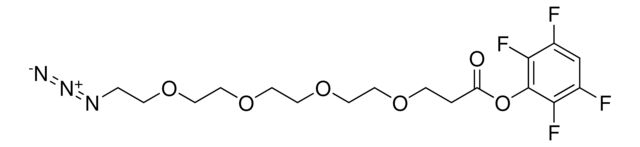
- Features and Benefits: The azido-dPEG®4 contains an azide function on one end of a single molecular weight dPEG® spacer (17.7 Å) and a reactive group on the other end of the spacer. The dPEG® spacer is hydrophilic and non-immunogenic and improves the water solubility of the target molecule while reducing the immunogenicity and increasing the hydrodynamic volume of the target. The acid function may be activated with 1-ethyl-3-(3-dimethylaminopropyl)carbodiimide (EDC) or N,N′-dicyclohexylcarbodiimide (DCC) for conjugation to an amine. The azide group reacts with an alkyne in the well-known click chemistry reaction. The click chemistry reaction proceeds by copper(I) or ruthenium catalysis or in a strain-catalyzed reaction with certain types of alkyne partners.
- Legal Information: Products Protected under U.S. Patents # 7,888,536 B2
SAFETY INFORMATION
WGK
WGK 3
Flash Point(F)
Not applicable
Flash Point(C)
Not applicable