69892
MES monohydrate
Manufacturer: Sigma Aldrich
CAS Number: 145224-94-8
Synonym(S): 2-(4-morpholino)ethanesulfonic acid, 2-morpholinoethanesulfonic acid, Morpholine-4-ethanesulfonic acid hydrate, 2-(N-Morpholino)ethanesulfonic acid, 4-Morpholineethanesulfonic acid monohydrate
Select a Size
| Pack Size | SKU | Availability | Price |
|---|---|---|---|
| 25 G | 69892-25-G | In Stock | ₹ 4,633.10 |
| 100 G | 69892-100-G | In Stock | ₹ 15,198.30 |
| 500 G | 69892-500-G | In Stock | ₹ 44,209.30 |
69892 - 25 G
In Stock
Quantity
1
Base Price: ₹ 4,633.10
GST (18%): ₹ 833.958
Total Price: ₹ 5,467.058
product line
BioXtra
Quality Level
200
Assay
≥99.0% (T)
form
powder or crystals
useful pH range
5.5-6.7
pKa (25 °C)
6.1
mp
>300 °C (lit.)
solubility
H2O: 0.5 M at 20 °C, clear
density
10.66 g/mL
anion traces
chloride (Cl-): ≤50 mg/kgsulfate (SO42-): ≤50 mg/kg
Other Options
| Image | Product Name | Manufacturer | Price Range | |
|---|---|---|---|---|
Sigma Aldrich Fine Chemicals Biosciences MES Monohydrate | 145224-94-8 | MFCD00149409 | 10g | -- | ₹ 10,902.50 | ||
Sigma Aldrich Fine Chemicals Biosciences MES monohydrate BioUltra, for molecular biology, >=99.5% (T) | 145224-94-8 | MFCD00149409 | 250G | -- | ₹ 1,32,325.20 | ||
Dojindo Molecular Technologies Inc MES (100G), Good's buffer, CAS: 145224-94-8, pka=6.15, Active pH 5.5-7, made in Japan | -- | ₹ 8,495.05 | ||
Sigma Aldrich Fine Chemicals Biosciences MES monohydrate BioUltra, for molecular biology, >=99.5% (T) | 145224-94-8 | MFCD00149409 | 50G | -- | ₹ 34,779.42 | ||
Sigma Aldrich Fine Chemicals Biosciences MES monohydrate | 145224-94-8 | MFCD00149409 | 500g | -- | ₹ 81,180.46 | ||
MES monohydrate | -- | ₹ 30,439.90 | ||
2-Morpholinoethanesulfonic acid monohydrate (MES) | -- | ₹ 28,122.00 - ₹ 12,14,702.00 | ||
MES monohydrate | -- | ₹ 35,101.15 - ₹ 24,40,031.86 | ||
MES Monohydrate | -- | ₹ 10,160.00 - ₹ 79,800.00 | ||
MES monohydrate | -- | ₹ 35,101.15 - ₹ 24,40,031.86 |
Related Products


Description
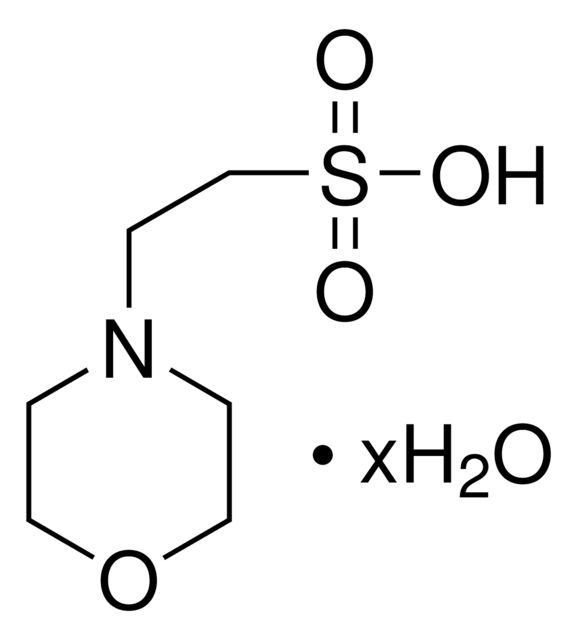
- General description: MES monohydrate, also known as 2-Morpholinoethanesulfonic acid hydrate, is a buffer used in research applications in biology and biochemistry. MES is a pH buffering compound with a pKa value of 6.15 at 20 oC. MES was developed in the 1960s as one of Good′s buffers, which were designed with various criteria in mind, including midrange pKa, maximum water solubility, minimum solubility in all other solvents, and minimal change in pKa with temperature. MES is highly soluble in water and only weakly binds with certain metal ions, including Ca, Mg, Mn, and Cu(II), which makes it a non-coordinating buffer in chemistry involving metal ions. Further, It plays a crucial role in maintaining a stable environment in various applications, including cell culture media, protein-based buffer formulations, and electrophoresis running buffers. MES monohydrate finds extensive use in purifying antibodies, peptides, proteins, blood components, and growth factors. It also stands out as an excellent choice for capillary electrochromatography due to its low ionic mobility, offering a safer alternative to toxic compounds like cacodylate and non-zwitterionic buffers such as citrate and malate. Additionally, MES Monohydrate serves various purposes, including pH adjustment in growth media, stabilizing enzymatic solutions, and as a component of PAGE running buffers in diverse experimental settings.
- Application: MES Monohydrate has been used:to adjust the pH of the growth medium, facilitating gene expression analyses aimed at understanding the molecular mechanisms[1]in the fixation and imaging of cellular components, enabling the study of hypotonic stress′s physiological effects on cell structure and function through Super-Resolution and Live-Cell Microscopy[2]to adjust the pH of the growth medium to 5.5-7.0 in an in vitro cell wall stress assay[3]as a buffering agent to stabilize enzymatic solutions[4]as a component of PAGE running buffer[5]
- Features and Benefits: Suitable for Biochemical and Cell Biology ResearchTested for the presence of anionic and cationic tracesTested to confirm low levels of heavy metal contamination, ensuring suitability for various applicationsEffective Buffering from pH 5.5-6.7 (25 °C) with a pKa of 6.1 (25 °C)
- Preparation Note: A buffer using MES free acid can be prepared by titrating the free acid with sodium hydroxide to the desired pH (pKa =±1). Alternatively, volumes of equimolar MES free acid and sodium MES can be mixed to attain the desired pH. Standard mixing tables using stock solutions to prepare a buffer of a given pH have been published.[6]
- Other Notes: Solubility/Stability: MES is soluble in water, giving a clear colourless solution at concentrations of 0.5M or higher. The pH of a solution should be between 2.5 and 5, depending on the concentration. Solutions are stable at 2-8°C for months. Sterilization: Sterilization should be by filteration through 0.2μM filters. Autoclaving is not recommended by any sulfonic acid buffers. If buffers must be nuclease-free, it is best to treat the water, then add the buffer solids after autoclaving. When MES solutions are autoclaved, they turn yellow (although pH does not change measurably. The identity of the yellow breakdown product is unkown.
SAFETY INFORMATION
WGK
WGK 1
Personal Protective Equipment
dust mask type N95 (US), Eyeshields, Gloves