TROY Polyclonal Antibody, Invitrogen™
Manufacturer: Thermo Scientific
Select a Size
| Pack Size | SKU | Availability | Price |
|---|---|---|---|
| Each of 1 | 01-676-658-Each-of-1 | In Stock | ₹ 46,502.50 |
01-676-658 - Each of 1
In Stock
Quantity
1
Base Price: ₹ 46,502.50
GST (18%): ₹ 8,370.45
Total Price: ₹ 54,872.95
Antigen
TROY
Classification
Polyclonal
Conjugate
Unconjugated
Gene
Tnfrsf19
Gene Alias
AL023044; AW123854; RGD1564996; TAJ; TAJ-alpha; TNF receptor superfamily member 19; Tnfrsf19; Toxicity and JNK inducer; TRADE; TROY; tumor necrosis factor receptor superfamily member 19; tumor necrosis factor receptor superfamily, member 19; UNQ1888/PRO4333
Host Species
Rabbit
Purification Method
Protein G
Regulatory Status
RUO
Gene ID (Entrez)
29820, 55504
Content And Storage
Store at 4°C short term. For long term storage, store at -20°C, avoiding freeze/thaw cycles.
Form
Liquid
Applications
Western Blot
Concentration
0.5 mg/mL
Formulation
PBS with 0.05% BSA and 0.05% sodium azide
Gene Accession No.
Q9JLL3, Q9NS68
Gene Symbols
Tnfrsf19
Immunogen
Synthetic peptides corresponding to residues 29-44, 204-219, and 409-421 of human TROY.
Quantity
100 μg
Primary or Secondary
Primary
Target Species
Human, Mouse
Product Type
Antibody
Isotype
IgG
Related Products



Description
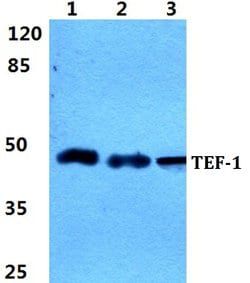
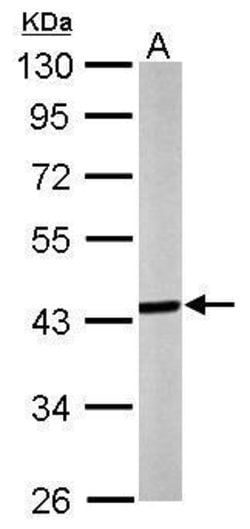
- In Western blot, this antibody detects a band at ∽46 kDa (predicted molecular weight 50.8 kDa
- For optimal results, primary antibody incubations should be performed at room temperature
- Suggested positive control: antigen standard for TNFRSF19 (transient overexpression lysate), T98G
- TROY can mediate activation of c-Jun and NF-kappa-B
- May promote caspase-independent cell death
- Isoform 2 and isoform 3 may act as decoy receptors.