CD56 (NCAM) Monoclonal Antibody (TULY56), Brilliant Violet™ 650, eBioscience™, Invitrogen™
Mouse Monoclonal Antibody
Manufacturer: Fischer Scientific
The price for this product is unavailable. Please request a quote
Antigen
CD56 (NCAM)
Concentration
5 μL/Test
Classification
Monoclonal
Form
Liquid
Regulatory Status
RUO
Formulation
PBS with BSA and 0.09% sodium azide; pH 7.2
Gene Alias
adhesion molecule; antigen recognized by monoclonal antibody 5.1H11; Cd56; CD-56; CD56 120 kDa GPI-linked isoform; CD56 140 kDa isoform; CD56 140 kDa VASE isoform; E NCAM; E-NCAM; MSK39; N CAM1; NCAM; N-CAM; Ncam1; N-CAM-1; NCAM-1; NCAMC; NCAM-C; neural cell adhesion molecule; Neural cell adhesion molecule 1; neural cell adhesion molecule, NCAM; sCD56; sNCAM; soluble CD56; soluble NCAM
Gene Symbols
Ncam1
Primary or Secondary
Primary
Content And Storage
4° C, store in dark, DO NOT FREEZE!
Clone
TULY56
Applications
Flow Cytometry
Conjugate
Brilliant Violet 650
Host Species
Mouse
Target Species
Human, Non-human Primate, Rhesus Monkey
Gene Accession No.
P13591
Gene ID (Entrez)
4684, 693789
Isotype
IgG1 κ
Purification Method
Affinity chromatography
Gene
Ncam1
Related Products
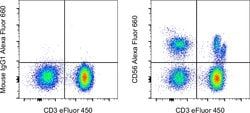


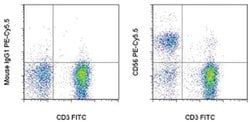
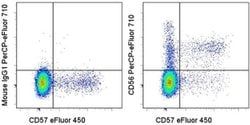
Description
- CD56 (NCAM, neural cell adhesion molecule) is a transmembrane glycoprotein of the immunoglobulin family that serves as an adhesive molecule and is ubiquitously expressed in the nervous system in isoforms ranging from 120-180 kDa
- CD56 is found on T cells and NK cells, and is involved in cell migration, axonal growth, pathfinding and synaptic plasticity
- Polysialic modification results in reduction of CD56-mediated cell adhesion
- Through its extracellular region, CD56 mediates homophilic and heterophilic interactions by binding extracellular matrix components such as laminin and integrins
- CD56 is expressed on most neuroectodermal derived cell lines, tissues and neoplasms such as retinoblastoma, medulloblastoma, astrocytomas and neuroblastoma
- Further, CD56 is a widely used neuroendocrine marker with a high sensitivity for neuroendocrine tumors and ovarian granulosa cell tumors
- Diseases associated with CD56 dysfunction include rabies and blastic plasmacytoid dendritic cell neoplasms.