CD209 (DC-SIGN) Monoclonal Antibody (eB-h209), PE-Cyanine7, eBioscience™, Invitrogen™
Manufacturer: Invitrogen
Select a Size
| Pack Size | SKU | Availability | Price |
|---|---|---|---|
| Each of 1 | 25-209-942-Each-of-1 | In Stock | ₹ 33,731.00 |
25-209-942 - Each of 1
In Stock
Quantity
1
Base Price: ₹ 33,731.00
GST (18%): ₹ 6,071.58
Total Price: ₹ 39,802.58
Antigen
CD209 (DC-SIGN)
Classification
Monoclonal
Concentration
5 μL/Test
Formulation
PBS with 0.2% BSA and 0.09% sodium azide; pH 7.2
Gene Accession No.
Q9NNX6
Gene Symbols
CD209
Purification Method
Affinity chromatography
Regulatory Status
RUO
Gene ID (Entrez)
30835
Content And Storage
4° C, store in dark, DO NOT FREEZE!
Form
Liquid
Applications
Flow Cytometry
Clone
eB-h209
Conjugate
PE-Cyanine7
Gene
CD209
Gene Alias
CD209; CD209 antigen; CD209 antigen-like protein A; CD209 molecule; Cd209a; CD209a antigen; CD209a molecule; Cd209d; CD209d antigen; CDSIGN; Cire; CLEC4L; Clec4m; C-type lectin domain family 4 member L; C-type lectin domain family 4, member L; C-type lectin domain family 4, member M; Dcsign; DC-SIGN; DC-SIGN1; Dc-signr; DC-SIGN-related protein; Dendritic cell-specific ICAM-3-grabbing non-integrin; dendritic cell-specific ICAM-3-grabbing non-integrin 1; dendritic cell-specific intercellular adhesion molecule-3-grabbing non-integrin; dendritic cell-specific intracellular adhesion molecules (ICAM)-3 grabbing non-integrin; HIV gpl20-binding protein; MGC129965; MGC130443; RGD1561104; SIGN-R1; SIGNR5
Host Species
Rat
Quantity
100 Tests
Primary or Secondary
Primary
Target Species
Human
Product Type
Antibody
Isotype
IgG2a κ
Related Products
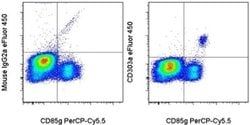
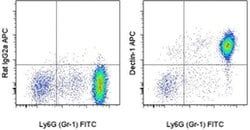
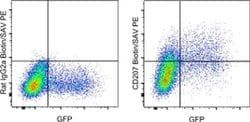
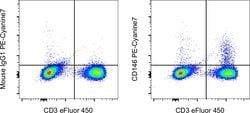
Description
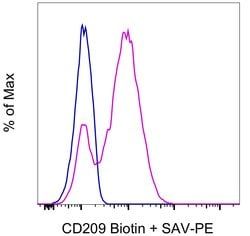
- The eB-h209 MAb reacts with human CD209, also known as DC-SIGN, a 44 kDa type II transmembrane protein
- DC-SIGN contains a C-type lectin binding domain and binds ICAM-3, ICAM-2, and HIV virus
- Human dendritic cells preferentially express DC-SIGN
- It has been postulated that DC-SIGN serves as a receptor for capture, trafficking, and transmission of HIV to T cells and supports primary immune response
- eB-h209 was developed against a C-terminal peptide of human DC-SIGN
- This gene encodes a transmembrane receptor and is often referred to as DC-SIGN because of its expression on the surface of dendritic cells and macrophages
- The encoded protein is involved in the innate immune system and recognizes numerous evolutionarily divergent pathogens ranging from parasites to viruses with a large impact on public health
- The protein is organized into three distinct domains: an N-terminal transmembrane domain, a tandem-repeat neck domain and C-type lectin carbohydrate recognition domain
- The extracellular region consisting of the C-type lectin and neck domains has a dual function as a pathogen recognition receptor and a cell adhesion receptor by binding carbohydrate ligands on the surface of microbes and endogenous cells
- The neck region is important for homo-oligomerization which allows the receptor to bind multivalent ligands with high avidity
- Variations in the number of 23 amino acid repeats in the neck domain of this protein are rare but have a significant impact on ligand binding ability
- This gene is closely related in terms of both sequence and function to a neighboring gene (GeneID 10332; often referred to as L-SIGN)
- DC-SIGN and L-SIGN differ in their ligand-binding properties and distribution
- Alternative splicing results in multiple variants.