WNT1 Polyclonal Antibody, Invitrogen™
Manufacturer: Invitrogen
Select a Size
| Pack Size | SKU | Availability | Price |
|---|---|---|---|
| Each of 1 | 36-580-0-Each-of-1 | In Stock | ₹ 38,270.00 |
36-580-0 - Each of 1
In Stock
Quantity
1
Base Price: ₹ 38,270.00
GST (18%): ₹ 6,888.60
Total Price: ₹ 45,158.60
Antigen
WNT1
Classification
Polyclonal
Conjugate
Unconjugated
Gene
WNT1
Gene Alias
BMND16; INT1; Int-1; murine mammary tumor virus integration site; OI15; Proto-oncogene Int-1; proto-oncogene Int-1 homolog; proto-oncogene protein Wnt-1; proto-oncogene Wnt-1; sw; swaying; wingless-related MMTV integration site 1; Wingless-type MMTV integration site 1 homolog; Wingless-type MMTV integration site 1, homolog; wingless-type MMTV integration site family member 1; wingless-type MMTV integration site family, member 1; wingless-type MMTV integration site family, member 1 (oncogene INT1); Wnt family member 1; Wnt1; Wnt-1
Host Species
Rabbit
Purification Method
Antigen affinity chromatography
Regulatory Status
RUO
Gene ID (Entrez)
22408, 709009, 7471
Content And Storage
-20°C
Form
Liquid
Applications
Immunoprecipitation, Western Blot
Concentration
0.25 mg/mL
Formulation
PBS with 0.1% sodium azide; pH 7.4
Gene Accession No.
P04426, P04628
Gene Symbols
WNT1
Immunogen
Synthetic peptide derived from the C-terminal region of the human WNT1 protein.
Quantity
100 μg
Primary or Secondary
Primary
Target Species
Human, Mouse, Rhesus Monkey
Product Type
Antibody
Isotype
IgG
Related Products



Description
- Wnt proteins constitute a family of secreted glyocoproteins that activate signal transduction pathways to mediate tissue homeostasis, cell fate, cell proliferation, and self-renewal
- The canonical signaling pathway is initiated upon Wnt binding to a Frizzled family receptor and an LRP5/LRP6 coreceptor, which leads to activation of the beta-catenin cascade
- Non-canonical Wnt signals are activated by binding to a Frizzled family receptor and ROR2 coreceptor
- Extensive research has shown that deregulation of these pathways or its components can lead to cancer
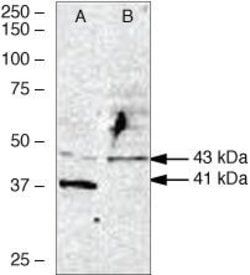
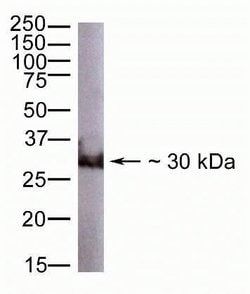
- Human Wnt-1 is encoded as a 370 amino acid precursor that, upon secretion, is cleaved into a 343 amino acid (42 kDa) mature form
- At the amino acid level, mature human Wnt-1 is approximately 99% identical to mature mouse Wnt-1
- Depending on the tissue, Wnt-1 can activate the canonical and non-canonical signaling pathways
- Studies have demonstrated its involvement in a variety of functions, including embryonic development and carcinogenesis
- Wnt-1 signaling can also induce the phosphorylation and subsequent degradation of c-Myb.