3851647
HAX-1 Mouse, Unlabeled, Clone: 52, BD
Mouse Monoclonal Antibody
Manufacturer: Fischer Scientific
The price for this product is unavailable. Please request a quote
Antigen
HAX-1
Concentration
250μg/mL
Classification
Monoclonal
Host Species
Mouse
Research Discipline
Cell Biology
Formulation
Aqueous buffered solution containing BSA, glycerol, and ≤0.09% sodium azide.
Isotype
IgG1
Purification Method
Affinity Purified
Clone
52
Applications
Western Blot
Conjugate
Unconjugated
Regulatory Status
RUO
Target Species
Human, Mouse, Rat
Immunogen
Human HAX-1 aa. 10-148
Primary or Secondary
Primary
Content And Storage
Store undiluted at -20°C.
Related Products

Description
- Cell-cell interactions in the immune system, mediated by membrane-bound antigen receptors, trigger a cascade of signaling mechanisms collectively known as the T-cell response
- Upon antigen binding, cellular tyrosine kinases are activated resulting in the phosphorylation of HS1 or Lck-binding protein 1 (LckBP1), which is involved in thymic negative selection
- HS1 is one of the earliest intracellular proteins to be tyrosine phosphorylated in response to antigen-receptor cross-linking in T cells
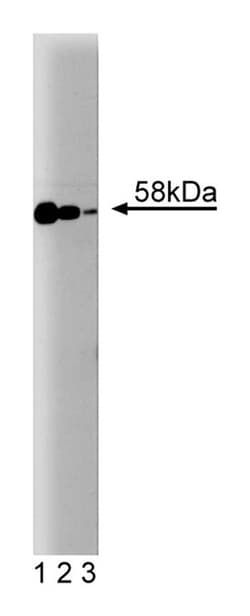
- HAX-1 (HS1-associated protein X-1) is a 35kDa protein found associated with HS1 by co-immunoprecipitation assays and the two-hybrid system
- HAX-1 is ubiquitously expressed and localized in the mitochondria, endoplasmic reticulum, and the nuclear envelope
- The HS1-HAX-1 complex may be critical for signal transduction pathways initiated by antigen presentation to T cells
- Immunofluorescence, Immunoprecipitation, Western Blotting