CD357 (AITR/GITR) Monoclonal Antibody (eBioAITR), APC-eFluor™ 780, eBioscience™, Invitrogen™
Manufacturer: Fischer Scientific
Select a Size
| Pack Size | SKU | Availability | Price |
|---|---|---|---|
| Each of 1 | 47-587-542-Each-of-1 | In Stock | ₹ 36,757.00 |
47-587-542 - Each of 1
In Stock
Quantity
1
Base Price: ₹ 36,757.00
GST (18%): ₹ 6,616.26
Total Price: ₹ 43,373.26
Antigen
CD357 (AITR/GITR)
Classification
Monoclonal
Concentration
5 μL/Test
Formulation
PBS with 0.2% BSA and 0.09% sodium azide; pH 7.2
Gene Accession No.
Q9Y5U5
Gene Symbols
Tnfrsf18
Purification Method
Affinity chromatography
Regulatory Status
RUO
Gene ID (Entrez)
8784
Content And Storage
4° C, store in dark, DO NOT FREEZE!
Form
Liquid
Applications
Flow Cytometry
Clone
eBioAITR
Conjugate
APC-eFluor 780
Gene
Tnfrsf18
Gene Alias
Activation-inducible TNFR family receptor; AITR; CD357; GITR; GITR-D; glucocorticoid-induced TNFR-related protein; PRO364; TNF receptor superfamily activation-inducible protein; TNF receptor superfamily member 18; TNFRSF18; Tumor necrosis factor receptor superfamily member 18; tumor necrosis factor receptor superfamily, member 18; UNQ319; UNQ319/PRO364
Host Species
Mouse
Quantity
100 Tests
Primary or Secondary
Primary
Target Species
Human
Product Type
Antibody
Isotype
IgG1 κ
Related Products

Description
- Mouse Monoclonal Antibody Tumor necrosis factor receptor superfamily member 18 (TNFRSF18), also called GITR or AITR is a protein that in humans is encoded by the TNFRSF18 gene
- It is mapped to 1p36.33
- This gene encodes a member of the TNF-receptor superfamily
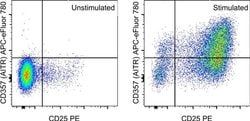
- The encoded receptor has been shown to have increased expression upon T-cell activation, and it is thought to play a key role in dominant immunological self-tolerance maintained by CD25 (+)CD4 (+) regulatory T cells
- Knockout studies in mice also suggest the role of this receptor is in the regulation of CD3-driven T-cell activation and programmed cell death
- Three alternatively spliced transcript variants of this gene encoding distinct isoforms have been reported.