CD127 Monoclonal Antibody (eBioSB/199 (SB/199)), eFluor™ 450, eBioscience™, Invitrogen™
Manufacturer: Invitrogen
Select a Size
| Pack Size | SKU | Availability | Price |
|---|---|---|---|
| Each | 48-127-382-Each | In Stock | ₹ 28,982.85 |
48-127-382 - Each
In Stock
Quantity
1
Base Price: ₹ 28,982.85
GST (18%): ₹ 5,216.913
Total Price: ₹ 34,199.763
Antigen
CD127
Classification
Monoclonal
Concentration
0.2 mg/mL
Formulation
PBS with 0.09% sodium azide; pH 7.2
Gene Accession No.
P16872
Gene Symbols
Il7r
Purification Method
Affinity chromatography
Regulatory Status
RUO
Gene ID (Entrez)
16197
Content And Storage
4° C, store in dark, DO NOT FREEZE!
Form
Liquid
Applications
Flow Cytometry
Clone
eBioSB/199 (SB/199)
Conjugate
eFluor 450
Gene
Il7r
Gene Alias
CD127; CD127 antigen; CDW127; IL 7 receptor; IL 7R a; IL 7R subunit alpha; IL 7R a; IL 7Ra; IL 7Ra; IL7 receptor; IL-7 receptor alpha chain; IL7 receptor subunit alpha; IL-7 receptor subunit alpha; IL7R; IL-7R; IL7R a; IL7R alpha; IL7R subunit alpha; IL-7R subunit alpha; IL7R a; IL7RA; IL-7RA; IL-7Ralpha; IL-7R-alpha; IL7Ra; ILRA; interleukin 7 receptor; interleukin 7 receptor alpha chain; interleukin 7 receptor isoform H5-6; Interleukin7 receptor subunit alpha; interleukin-7 receptor subunit alpha; MGC107557; sCD127; soluble IL 7 receptor; soluble IL 7R
Host Species
Rat
Quantity
100 μg
Primary or Secondary
Primary
Target Species
Mouse
Product Type
Antibody
Isotype
IgG2b κ
Related Products




Description
- Description: The SB/199 monoclonal antibody reacts with mouse CD127, the high affinity a subunit of the mouse IL-7 receptor
- IL-7 receptor a chain is expressed by immature B cells in the bone marrow, double-negative (CD4-/CD8-), single-positive (CD4+ and CD8+), but not double-positive (CD4+/CD8+) thymocytes
- In the periphery, mature T cells express low levels of CD127
- Binding of SB/199 blocks the binding of A7R34, another antibody which recognizes mouse CD127
- Applications Reported: This eBioSB/199 (SB/199) antibody has been reported for use in flow cytometric analysis
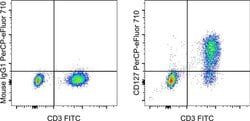
- Applications Tested: This eBioSB/199 (SB/199) antibody has been tested by flow cytometric analysis of mouse splenocytes
- This can be used at less than or equal to 0.5 μg per test
- A test is defined as the amount (μg) of antibody that will stain a cell sample in a final volume of 100 μL
- Cell number should be determined empirically but can range from 10^5 to 10^8 cells/test
- It is recommended that the antibody be carefully titrated for optimal performance in the assay of interest
- eFluor™ 450 is an alternative to Pacific Blue™
- eFluor™ 450 emits at 445 nm and is excited with the Violet laser (405 nm)
- Please make sure that your instrument is capable of detecting this fluorochome
- Excitation: 405 nm; Emission: 445 nm; Laser: Violet Laser
- Filtration: 0.2 μm post-manufacturing filtered
- CD127 (Interleukin-7, IL-7) is a glycoprotein involved in the regulation of lymphopoiesis
- The response of cells to CD127 is dependent on the presence of the interleukin 7 receptor (IL7R); the active receptor is an alpha/gamma chain heterodimer
- CD127 consists of an alpha chain and a gamma chain
- The gamma(c) chain, which also associates with the interleukin-2 receptor, serves primarily to activate signal transduction by the IL7R complex, while the alpha chain of IL7R determines specific signaling events through its association with cytoplasmic signaling molecules
- CD127 promotes the proliferation of precursor B cells, thymocytes, T cell progenitors, and mature CD4+ and CD8+ T cells
- The biological effects of IL7 are mediated by the binding of IL7 to the specific cell surface receptor
- Diseases associated with CD127 dysfunction include severe combined immunodeficiency and T cell negative/B cell negative/NK positive severe combined immunodeficiency.