50-100-77
CD282 (TLR2) Monoclonal Antibody (TL2.1), FITC, eBioscience™, Invitrogen™
Manufacturer: Invitrogen
Select a Size
| Pack Size | SKU | Availability | Price |
|---|---|---|---|
| Each of 1 | 50-100-77-Each-of-1 | In Stock | ₹ 25,810.00 |
50-100-77 - Each of 1
In Stock
Quantity
1
Base Price: ₹ 25,810.00
GST (18%): ₹ 4,645.80
Total Price: ₹ 30,455.80
Antigen
CD282 (TLR2)
Classification
Monoclonal
Concentration
5 μL/Test
Formulation
PBS with 0.2% BSA and 0.09% sodium azide; pH 7.2
Gene Accession No.
O60603
Gene Symbols
Tlr2
Purification Method
Affinity chromatography
Regulatory Status
RUO
Gene ID (Entrez)
7097
Content And Storage
4° C, store in dark, DO NOT FREEZE!
Form
Liquid
Applications
Flow Cytometry
Clone
TL2.1
Conjugate
FITC
Gene
Tlr2
Gene Alias
CD282; Ly105; TIL4; Tlr2; TLR-2; toll like receptor 2; toll/interleukin-1 receptor-like protein 4; Toll-like receptor; toll-like receptor 2; toll-like receptor 2 variant 1; toll-like receptor 2 variant 2; toll-like-receptor 2, exon 1a_; Toll-like-receptor, exon 1b; Toll-like-receptor, exon 1b_; Toll-like-receptor2, exon 1a
Host Species
Mouse
Quantity
100 Tests
Primary or Secondary
Primary
Target Species
Human
Product Type
Antibody
Isotype
IgG2a κ
Related Products

Description
- Description: The TL2.1 monoclonal antibody reacts with human Toll-like receptor 2 (TLR2)
- To date, at least ten members of the Toll family have been identified in human
- This family of type I transmembrane proteins is characterized by an extracellular domain with leucine-rich repeats and a cytoplasmic domain with homology to the type I IL-1 receptor
- Two of these receptors, TLR2 and TLR4, are pattern recognition receptors and signaling molecules in response to bacterial lipoproteins and have been implicated in innate immunity and inflammation
- TLR2 is expressed by peripheral blood monocytes and is responsible for distinguishing different pathogens
- TL2.1, a blocking antibody, has been used to study the role of TLR-2 as a pattern recognition receptor in microbial lipoprotein/lipopeptide induced cytokine production from human peripheral blood mononuclear cells
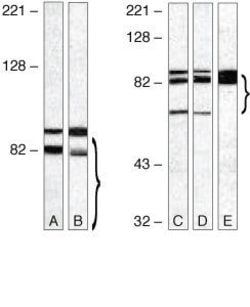
- TL2.1 has been reported to immunoprecipitate human TLR2 (∽90 kDa) from PBMC and HMEC
- Applications Reported: The TL2.1 antibody has been reported for use in flow cytometric analysis
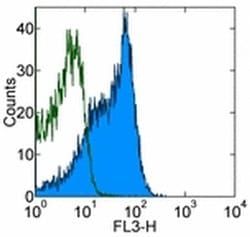
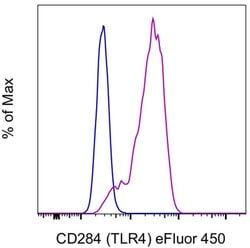
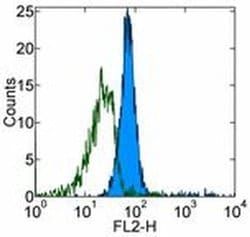
- Applications Tested: This TL2.1 antibody has been pre-titrated and tested by flow cytometric analysis of normal human peripheral blood cells
- This can be used at 5 μL (1 μg) per test
- A test is defined as the amount (μg) of antibody that will stain a cell sample in a final volume of 100 μL
- Cell number should be determined empirically but can range from 10^5 to 10^8 cells/test
- TLR2 is a member of the Toll-like receptor (TLR) family which play a fundamental role in pathogen recognition and activation of innate immunity
- TLR proteins act through adaptor molecules such as MyD88 and TIRAP to activate various kinases and transcription factors such as Protein Kinase C (PKC) alpha/beta and NF-kappa-B
- TLR2 can form heterodimers with either TLR1 or TLR6, and as a heterodimer, can recognize a variety of bacterial and mycoplasma lipoproteins respectively
- TLRs are highly conserved from Drosophila to humans and share structural and functional similarities
- The various TLRs exhibit different patterns of expression
- TLR2 is expressed most abundantly in peripheral blood leukocytes, and mediates host response to Gram-positive bacteria and yeast via stimulation of NF-kappaB
- TLR2 aids in the recognition of pathogen-associated molecular patterns (PAMPs) that are expressed on infectious agents, and mediate the production of cytokines necessary for the development of effective immunity
- Ten human homologs of TLRs (TLR1-10) have been described
- TLR2 is expressed in human cells such as tonsils, microglia, lymph nodes, and appendices, activated B-cells in germinal centers
- CD14+ monocytes express the highest level of TLR2 followed by CD15+ granulocytes, CD19+ B-cells, and CD3+ T-cells
- The expression of TLR2 on different cell types are regulated by different immune response modifiers
- For example, LPS, GM-CSF, IL-1, and IL-10 up regulates TLR2 whereas IL-4, IFN-gamma, and TNF down regulate TLR2 expression in monocytes.