CD193 (CCR3) Monoclonal Antibody (eBio5E8-G9-B4 (5E8-G9-B4)), PE, eBioscience™, Invitrogen™
Manufacturer: Invitrogen
Select a Size
| Pack Size | SKU | Availability | Price |
|---|---|---|---|
| Each | 50-106-93-Each | In Stock | ₹ 16,700.85 |
50-106-93 - Each
In Stock
Quantity
1
Base Price: ₹ 16,700.85
GST (18%): ₹ 3,006.153
Total Price: ₹ 19,707.003
Antigen
CD193 (CCR3)
Classification
Monoclonal
Concentration
5 μL/Test
Formulation
PBS with 0.2% BSA and 0.09% sodium azide; pH 7.2
Gene Accession No.
P51677
Gene Symbols
CCR3
Purification Method
Affinity chromatography
Regulatory Status
RUO
Gene ID (Entrez)
1232
Content And Storage
4° C, store in dark, DO NOT FREEZE!
Form
Liquid
Applications
Flow Cytometry
Clone
eBio5E8-G9-B4 (5E8-G9-B4)
Conjugate
PE
Gene
CCR3
Gene Alias
b-chemokine receptor; CC chemokine receptor 3; C-C chemokine receptor type 3; C-C CKR-3; C-C motif chemokine receptor 3; CC-CKR3; CC-CKR-3; Ccr3; CCR-3; CD193; chemokine (C-C motif) receptor 3; chemokine (C-C) receptor 1,-like 2; chemokine (C-C) receptor 3; CKR3; Cmkbr1l2; CMKBR3; eosinophil CC chemokine receptor 3; eosinophil eotaxin receptor; Macrophage inflammatory protein 1-alpha receptor-like 2; MGC102841; MIP-1 alpha RL2; MIP-1 alphaRL2; probable C-C chemokine receptor type 3
Host Species
Mouse
Quantity
100 Tests
Primary or Secondary
Primary
Target Species
Human
Product Type
Antibody
Isotype
IgG2b κ
Related Products



Description
- Description: The eBio5E8-G9-B4 monoclonal antibody reacts with human CD193 (CCR3, CKR3)
- CD193 is a member of the seven transmembrane G-protein coupled receptor (GPCR) family, and is a high affinity chemokine receptor for the chemokines eotaxin-1 (CCL11), eotaxin-2 (CCL24), eotaxin-3 (CCL26) and MCP-4 (CCL13), but has also been reported to bind RANTES, MCP-3 and MCP-4
- CD193 is highly expressed on the surface of eosinophils, and is the key eosinophil chemokine receptor responsible for the regulation of eosinophil migration and function
- In addition to eosinophils, CD193 is also expressed on CD4+ TH2 cells, basophils, mast cells, mononuclear phagocytes, platelets, CD34+ hematopoietic progenitors and airway epithelial cells
- CD193 likely plays an important role in the migration of eosinophils in allergic airway inflammation and asthma
- CD193 can also serve as a receptor for HIV-1 cell entry
- Applications Reported: This eBio5E8-G9-B4 (5E8-G9-B4) antibody has been reported for use in flow cytometric analysis
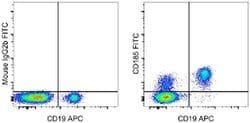
- Applications Tested: This eBio5E8-G9-B4 (5E8-G9-B4) antibody has been pre-titrated and tested by flow cytometric analysis of normal human peripheral blood cells
- This can be used at 5 μL (0.06 μg) per test
- A test is defined as the amount (μg) of antibody that will stain a cell sample in a final volume of 100 μL
- Cell number should be determined empirically but can range from 10^5 to 10^8 cells/test
- CCR3 (C-C chemokine receptor type 3) binds to eotaxin, eotaxin-3, MCP-3, MCP-4, RANTES, and MIP-1 delta
- CCR3 trasnduces a signal by increasing the intracellular calcium ions level
- It also serves as an alternative co-receptor with CD4 for HIV-1 infection
- Other chemokines play important roles in inflammation and are critical for the recruitment of effector immune cells to sites of infection
- Chemokines activate leukocytes by binding to G protein coupled receptors
- The ever-growing chemokine receptor subtypes can be divided into 2 major groups, CXCR and CCR, based on the 2 major classes of chemokines.