50-112-2290
CD194 (CCR4) Monoclonal Antibody (D8SEE), PE, eBioscience™, Invitrogen™
Manufacturer: Invitrogen
Select a Size
| Pack Size | SKU | Availability | Price |
|---|---|---|---|
| Each of 1 | 50-112-2290-Each-of-1 | In Stock | ₹ 31,595.00 |
50-112-2290 - Each of 1
In Stock
Quantity
1
Base Price: ₹ 31,595.00
GST (18%): ₹ 5,687.10
Total Price: ₹ 37,282.10
Antigen
CD194 (CCR4)
Classification
Monoclonal
Concentration
5 μL/Test
Formulation
PBS with 0.2% BSA and 0.09% sodium azide; pH 7.2
Gene Accession No.
P51679
Gene Symbols
Ccr4
Purification Method
Affinity chromatography
Regulatory Status
RUO
Gene ID (Entrez)
1233
Content And Storage
4° C, store in dark, DO NOT FREEZE!
Form
Liquid
Applications
Flow Cytometry
Clone
D8SEE
Conjugate
PE
Gene
Ccr4
Gene Alias
C-C chemokine receptor 4; C-C chemokine receptor type 4; C-C CKR-4; C-C motif chemokine receptor 4; CC-CKR-4; Ccr4; CCR-4; CD194; chemokine (C-C motif) receptor 4; chemokine (C-C) receptor 4; CHEMR1; ChemR13; CKR4; Cmkbr4; fusin; HGCN:14099; K5-5; LESTR; leukocyte-expressed seven-transmembrane-domain receptor; MGC88293; Sdf1r
Host Species
Mouse
Quantity
100 Tests
Primary or Secondary
Primary
Target Species
Human
Product Type
Antibody
Isotype
IgG1 κ
Related Products



Description
- Description: This D8SEE monoclonal antibody reacts with human CD194 (CCR4)
- CD194, also known as C-C Chemokine Receptor 4 (CCR4) is a member of the G protein-coupled receptor family, a large family characterized by seven transmembrane alpha helical domains
- The ligands for CCR4 are CCL17 (TARC) and CCL22 (MDC), which direct the migration of target cells
- CCR4 and its ligands, along with the other receptors CCR10 and CLA, are particularly important for the recruitment of T cells into the skin, where they may also play a role in adhesion and extravasation
- Although CCR4 expression was originally believed to be restricted to Th2 cells, it has since been observed in some subsets of Th17, Treg, and Th1 cells
- It is not expressed by naive T cells, indicating a role in memory or effector function
- Other cells that express CCR4 are activated NK cells, platelets, monocytes, and basophils
- Applications Reported: This D8SEE antibody has been reported for use in flow cytometric analysis
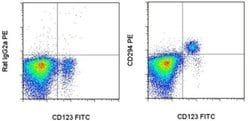
- Applications Tested: This D8SEE antibody has been pre-titrated and tested by flow cytometric anaylis of normal human peripheral blood cells
- This can be used at 5 μL (0.25 μg) per test
- A test is defined as the amount (μg) of antibody that will stain a cell sample in a final volume of 100 μL
- Cell number should be determined empirically but can range from 10^5 to 10^8 cells/test
- CCR4 is a chemokine receptor and is preferentially expressed on type 2 helper T (Th2-type) cells
- In contrast to other chemokine receptors, the expression of CCR4 and CCR8 on Th2 cells is transiently increased following TCR and CD28 engagement
- Moreover, activated Th1 cells up-regulate CCR4 expression and functional responsiveness to thymus- and activation-regulated chemokine
- Chemokines are a group of small (approximately 8 to 14 kD), mostly basic, structurally related molecules that regulate cell trafficking of various types of leukocytes through interactions with a subset of 7-transmembrane, G protein-coupled receptors
- Chemokines also play fundamental roles in the development, homeostasis, and function of the immune system, and they have effects on cells of the central nervous system as well as on endothelial cells involved in angiogenesis or angiostasis
- Chemokines are divided into 2 major subfamilies, CXC and CC, based on the arrangement of the first 2 of the 4 conserved cysteine residues; the 2 cysteines are separated by a single amino acid in CXC chemokines and are adjacent in CC chemokines.