Placental Alkaline Phosphatase Monoclonal Antibody (8B6), Biotin, eBioscience™, Invitrogen™
Manufacturer: Invitrogen
Select a Size
| Pack Size | SKU | Availability | Price |
|---|---|---|---|
| Each of 1 | 50-112-2620-Each-of-1 | In Stock | ₹ 35,600.00 |
50-112-2620 - Each of 1
In Stock
Quantity
1
Base Price: ₹ 35,600.00
GST (18%): ₹ 6,408.00
Total Price: ₹ 42,008.00
Antigen
Placental Alkaline Phosphatase
Classification
Monoclonal
Concentration
0.5 mg/mL
Formulation
PBS with 0.09% sodium azide; pH 7.2
Gene Accession No.
P05187
Gene Symbols
ALPP
Purification Method
Affinity chromatography
Regulatory Status
RUO
Gene ID (Entrez)
250
Content And Storage
4° C, store in dark, DO NOT FREEZE!
Form
Liquid
Applications
ELISA, Immunohistochemistry (Frozen), Immunohistochemistry (Paraffin)
Clone
8B6
Conjugate
Biotin
Gene
ALPP
Gene Alias
Alkaline phosphatase placental type; Alkaline phosphatase Regan isozyme; alkaline phosphatase, placental; alkaline phosphatase, placental type; alkaline phosphomonoesterase; ALP; Alp1; ALPP; AP-TNAP; DOA1; FLJ11281; FLJ40094; FLJ61142; FLJ93059; Germ-cell alkaline phosphatase; glycerophosphatase; HOPS; MGC161443; MGC167935; nagao Isozyme; P PLAP; PALP; PLA2P; PLAA; placental alkaline phosphatase 1; placental heat-stable alkaline phosphatase; PLAP; PLAP1; PLAP-1; rCG23846-like; Regan isozyme; TNAP; TNSALP
Host Species
Mouse
Quantity
100 μg
Primary or Secondary
Primary
Target Species
Human
Product Type
Antibody
Isotype
IgG2a κ
Related Products



Description
- Description: The monoclonal antibody 8B6 recognizes human Placental Alkaline Phosphatase (PLAP), a 130 (or 130 with 65 kDa) enzyme expressed by placental syncytiotrophoblastoid cells
- This enzyme has slightly different enzyme kinetics from other phosphatases
- PLAP can be found anchored to the plasma membrane in addition to the cytoplasm
- Expression is found in several germ line cancers; ovarian and testicular
- Expression is also present in human embryonic stem cells and bone marrow-derived mesenchymal stromal cells
- This 8B6 antibody reacts with both the Regan and Nagao isozymes
- Applications Reported: This 8B6 antibody has been reported for use in immunohistochemical staining of frozen (IHC-F) and formalin-fixed paraffin embedded (IHC-P) tissue, and ELISA
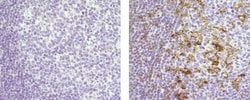
- Applications Tested: This 8B6 antibody has been tested by immunohistochemistry on formalin-fixed paraffin embedded (FFPE) human placenta with trypsin digestion
- This antibody can be used at less than or equal to 20 μg/mL
- It is recommended that the antibody be carefully titrated for optimal performance in the assay of interest
- Filtration: 0.2 μm post-manufacturing filtered
- Placental Alkaline Phosphatase plays an important role in the regulation of specific inflammatory disease processes
- There are at least four distinct but related alkaline phosphatases: intestinal, placental, placental-like, and liver/bone/kidney for this form of alkaline phosphatase have been well characterized
- Placental Alkaline Phosphatase reacts with a membrane-bound isoenzyme (Regan and Nagao type) of Placental Alkaline Phosphatase (PLAP) occurring in the placenta during the 3rd trimester of gestation
- Placental Alkaline Phosphatase is useful in the identification of testicular germ cell tumors
- Unlike germ cell tumors, PLAP-positive somatic cell tumors uniformly express epithelial membrane antigen (EMA)
- A proposed function of Placental Alkaline Phosphatase is matrix mineralization; however, mice that lack a functional form of this enzyme show normal skeletal development
- Placental Alkaline Phosphatase has been linked directly to hypophosphatasia, a disorder that is characterized by hypercalcemia and includes skeletal defects
- The character of hypophosphatasia can vary, however, depending on the specific mutation since this determines age of onset and severity of symptoms.