50-112-3379
Podoplanin Monoclonal Antibody (eBio8.1.1 (8.1.1)), PE-Cyanine7, eBioscience™, Invitrogen™
Manufacturer: Invitrogen
Select a Size
| Pack Size | SKU | Availability | Price |
|---|---|---|---|
| Each of 1 | 50-112-3379-Each-of-1 | In Stock | ₹ 33,731.00 |
50-112-3379 - Each of 1
In Stock
Quantity
1
Base Price: ₹ 33,731.00
GST (18%): ₹ 6,071.58
Total Price: ₹ 39,802.58
Antigen
Podoplanin
Classification
Monoclonal
Concentration
0.2 mg/mL
Formulation
PBS with 0.1% gelatin and 0.09% sodium azide; pH 7.2
Gene Accession No.
Q62011
Gene Symbols
Pdpn
Purification Method
Affinity chromatography
Regulatory Status
RUO
Gene ID (Entrez)
14726
Content And Storage
4° C, store in dark, DO NOT FREEZE!
Form
Liquid
Applications
Flow Cytometry
Clone
eBio8.1.1 (8.1.1)
Conjugate
PE-Cyanine7
Gene
Pdpn
Gene Alias
CTA-520D8.1, AGGRUS, GP36, GP40, Gp38, HT1A-1, OTS8, PA2.26, T1A, T1A-2
Host Species
Syrian Hamster
Quantity
100 μg
Primary or Secondary
Primary
Target Species
Mouse
Product Type
Antibody
Isotype
IgG
Related Products



Description
- Description: The 8.1.1 monoclonal antibody reacts with mouse podoplanin (T1a, gp38, aggrus), a 43 kDa transmembrane glycoprotein, named for its expression in kidney glomerular epithelial cells (podocytes)
- In addition, Podoplanin is expressed in epithelial and mesothelial cells such as intestinal epithelium, alveolar type I cells, podocytes, and mesothelium of the visceral peritoneum
- It was also shown to be a potent marker for lymphatic endothelium
- Podoplanin is also expressed by subcapsular epithelial cells of the murine thymus
- Mice deficient in Podoplanin die at birth because of a respiratory defect and congenital lymphedema due to a failure in lymphatic pattern formation
- Applications Reported: This eBio8.1.1 (8.1.1) antibody has been reported for use in flow cytometric analysis
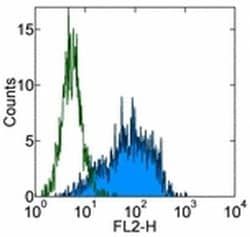
- Applications Tested: This eBio8.1.1 (8.1.1) antibody has been tested by flow cytometric analysis of the TE-71 cell line
- This can be used at less than or equal to 0.125 µg per test
- A test is defined as the amount (µg) of antibody that will stain a cell sample in a final volume of 100 µL
- Cell number should be determined empirically but can range from 10^5 to 10^8 cells/test
- It is recommended that the antibody be carefully titrated for optimal performance in the assay of interest
- Light sensitivity: This tandem dye is sensitive to photo-induced oxidation
- Please protect this vial and stained samples from light
- Fixation: Samples can be stored in IC Fixation Buffer (cat
- 00-8222) (100 µL of cell sample + 100 µL of IC Fixation Buffer) or 1-step Fix/Lyse Solution (cat
- 00-5333) for up to 3 days in the dark at 4°C with minimal impact on brightness and FRET efficiency/compensation
- Some generalizations regarding fluorophore performance after fixation can be made, but clone specific performance should be determined empirically
- Excitation: 488-561 nm; Emission: 775 nm; Laser: Blue Laser, Green Laser, Yellow-Green Laser
- Filtration: 0.2 μm post-manufacturing filtered
- Podoplanin (PDPN, T1A, gp38, Aggrus) is a mucin type-1 glycoprotein with a 40-43 kDa molecular weight
- Podoplanin is expressed in many tumors and normal cells, especially lymphatic epithelial cells and follicular DCs
- Podoplanin localizes in stromal cells of peripheral lymphoid tissue and thymic epithelial cells
- As a regulator of the lymphatic endothelium, podoplanin probably plays a role in maintaining the unique shape of podocytes
- Podoplanin appears to serve as a ligand for CLEC-2 and expression is positively correlated with tumors expressing greater invasive and metastatic potential
- Podoplanin is directly involved in cell migration, aids metastases formation and tumor cell invasion of tissue
- Further, it has also been determined that podoplanin expression is induced through Src activation of Cas and, recently, there are indications of podoplanin presence on Th17 cells
- Initial studies below indicate the presence of podoplanin on a small but distinct population of CD4+ cells from human PBMC
- Dysfunction of the podoplanin protein has been linked to diseases such as lymphangioma and subglottis neoplasm
- Podoplanin has also been proposed as a marker for lung injury due to the physiological function of the protein.