Phospho-LCK (Tyr505) Monoclonal Antibody (SRRCHA), PerCP-eFluor™ 710, eBioscience™, Invitrogen™
Manufacturer: Invitrogen
Select a Size
| Pack Size | SKU | Availability | Price |
|---|---|---|---|
| Each of 1 | 50-112-3936-Each-of-1 | In Stock | ₹ 40,584.00 |
50-112-3936 - Each of 1
In Stock
Quantity
1
Base Price: ₹ 40,584.00
GST (18%): ₹ 7,305.12
Total Price: ₹ 47,889.12
Antigen
Phospho-LCK (Tyr505)
Classification
Monoclonal
Concentration
5 μL/Test
Formulation
PBS with 0.2% BSA and 0.09% sodium azide; pH 7.2
Gene Accession No.
P06239, P06240
Gene Symbols
LCK
Immunogen
Phospho peptide
Quantity
100 Tests
Primary or Secondary
Primary
Target Species
Human, Mouse
Product Type
Antibody
Isotype
IgG1 κ
Applications
Flow Cytometry
Clone
SRRCHA
Conjugate
PerCP-eFluor 710
Gene
LCK
Gene Alias
EC 2.7.10.2; Hck-3; IMD22; kinase Lck; Lck; LCK proto-oncogene, Src family tyrosine kinase; Lck1; Lcktkr; leukocyte C-terminal Src kinase; LSK; Lskt; Lsk-t; Lymphocyte cell-specific protein-tyrosine kinase; lymphocyte protein tyrosine kinase; lymphocyte-specific protein tyrosine kinase; OTTHUMP00000008640; OTTHUMP00000008740; OTTHUMP00000008741; p56(LSTRA) protein-tyrosine kinase; p56<lck>; p56lck; p56-LCK; pp58lck; Protein YT16; Proto-oncogene Lck; Proto-oncogene tyrosine-protein kinase LCK; RP4-675E8.4; t cell-specific protein-tyrosine kinase; T-lymphocyte specific protein tyrosine kinase p56lck; tyr; tyrosine-protein kinase Lck; YT16
Host Species
Mouse
Purification Method
Affinity chromatography
Regulatory Status
RUO
Gene ID (Entrez)
16818, 3932
Content And Storage
4° C, store in dark, DO NOT FREEZE!
Form
Liquid
Related Products


Description
- Description: This SRRCHA monoclonal antibody recognizes human and mouse LCK when phosphorylated on tyrosine 505 (Y505)
- Y505 is a negative-regulatory site that is phosphorylated by the kinase CSK
- LCK is expressed in T cells where it associates with the cytoplasmic tails of the CD4 and CD8 co-receptors on T helper cells and cytotoxic T cells, respectively
- When the TCR is engaged, LCK acts to phosphorylate the intracellular chains of CD3 and zeta chains of the TCR complex, allowing the cytoplasmic tyrosine kinase, ZAP-70, to bind to them
- LCK then phosphorylates and activates ZAP-70, which then phosphorylates the adaptor protein, LAT, that serves as a docking site for a number of other proteins, including SLP-76, Grb2, and phospholipase C gamma1
- Mice lacking expression of LCK show defects in T cell development and function
- Applications Reported: This SRRCHA antibody has been reported for use in intracellular staining followed by flow cytometric analysis
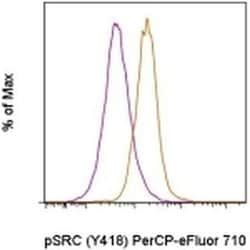
- Applications Tested: This SRRCHA antibody has been pre-titrated and tested by intracellular staining followed by flow cytometric analysis of activated human peripheral blood cells
- This can be used at 5 μL (0.06 μg) per test
- A test is defined as the amount (μg) of antibody that will stain a cell sample in a final volume of 100 μL
- Cell number should be determined empirically but can range from 10^5 to 10^8 cells/test
- LCK is a member of the Src-family tyrosine kinase, which are essential for signaling through the T-cell receptor (TCR) complex
- Upon TCR triggering, LCK phosphorylates the ITAM motives in its zeta subunits establishing binding sites for the SH2 domains of the tyrosine kinase ZAP70, which is also phosphorylated by LCK and activated to generate subsequent signaling platforms by phosphorylation of adaptor LAT
- The majority of LCK is localized to the plasma membrane, however, there is also a significant fraction associated with the Golgi apparatus which may contribute to Raf activation under conditions of weak stimulation through the TCR
- LCK contains N-terminal sites for myristylation and palmitylation, a PTK domain, and SH2 and SH3 domains which are involved in mediating protein-protein interactions with phosphotyrosine-containing and proline-rich motifs, respectively
- LCK is also involved in the regulation of apoptosis induced by various stimuli, but not by the death receptors
- Diseases associated with LCK include Immunodeficiency 22 and CD45 deficiency
- Alternatively splice variants of the LCK gene encoding different isoforms of the protein have been found.