Phospho-S6 (Ser235, Ser236) Monoclonal Antibody (cupk43k), eFluor™ 450, eBioscience™, Invitrogen™
Manufacturer: Invitrogen
Select a Size
| Pack Size | SKU | Availability | Price |
|---|---|---|---|
| Each of 1 | 50-112-4219-Each-of-1 | In Stock | ₹ 34,977.00 |
50-112-4219 - Each of 1
In Stock
Quantity
1
Base Price: ₹ 34,977.00
GST (18%): ₹ 6,295.86
Total Price: ₹ 41,272.86
Antigen
Phospho-S6 (Ser235, Ser236)
Classification
Monoclonal
Concentration
5 μL/Test
Formulation
PBS with 0.2% BSA and 0.09% sodium azide; pH 7.2
Gene Accession No.
P62753, P62754
Gene Symbols
RPS6
Purification Method
Affinity chromatography
Regulatory Status
RUO
Gene ID (Entrez)
20104, 6194
Content And Storage
4° C, store in dark, DO NOT FREEZE!
Form
Liquid
Applications
Flow Cytometry
Clone
cupk43k
Conjugate
eFluor 450
Gene
RPS6
Gene Alias
(Rp)S6; 40S ribosomal protein S6; air[8]; air8; anon-WO02059370.61; CG10944; CG10944-PA; CG10944-PB; Dmel\CG10944; Dmel_CG10944; DS6; hemocytes enlarged; hen; l(1)air[8]; l(1)air8; l(1)hen; LD31286p; lethal(1)aberrant immune response[8]; lethal-(1)-haemocytes enlarged; lethal-aberrant-immune-response-8; M(1)7BC; M(1)7C; minute; minute (1) 7BC; OK/SW-cl.2; OTTHUMP00000021121; OTTHUMP00000021122; Phosphoprotein NP33; pp30; ribosomal protein S6; Rp S6; RP11-513M16.6; RPS6; RpS6-PA; RpS6-PB; RS6; S6; S6 ribosomal protein; S6R; Small ribosomal subunit protein eS6; wu:fa92e06; wu:fb64g06; zgc:92237
Host Species
Mouse
Quantity
100 Tests
Primary or Secondary
Primary
Target Species
Human, Mouse
Product Type
Antibody
Isotype
IgG1 κ
Related Products



Description
- Description: This cupk43k monoclonal antibody recognizes human and mouse ribosomal protein S6 (also known as 40S ribosomal protein S6, phosphoprotein NP33, RPS6, RS6, S6) when phosphorylated on serine 235 (S235, human) and serine 236 (S236, mouse)
- Ribosomal protein S6 is a component of the 40S subunit of the ribosome and is phosphorylated at multiple sites following stimulation of cells by growth factors, tumor promoting agents, or mitogens
- Phosphorylation of ribosomal protein S6 by p70S6K and PKDCD results in upregulation of the translation of RNA coding for proteins involved in cell cycle entry
- Ribosomal protein S6 is dephosphorylated upon growth arrest
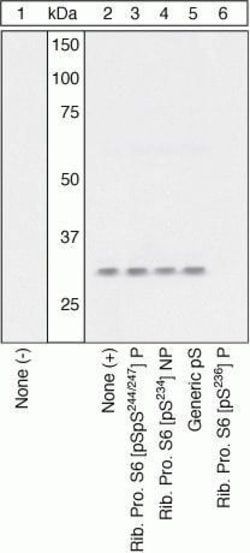
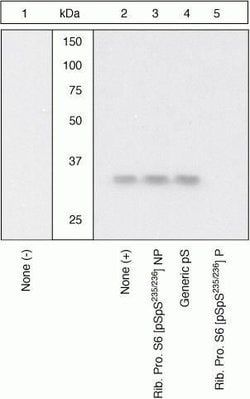
- The specificity of the cupk43k monoclonal antibody was determined by western blotting
- Applications Reported: This cupk43k antibody has been reported for use in intracellular staining followed by flow cytometric analysis
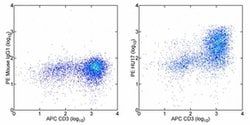
- Applications Tested: This cupk43k antibody has been pre-titrated and tested by intracellular staining and flow cytometric analysis of stimulated normal human peripheral blood cells
- This can be used at 5 μL (0.125 μg) per test
- A test is defined as the amount (μg) of antibody that will stain a cell sample in a final volume of 100 μL
- Cell number should be determined empirically but can range from 10^5 to 10^8 cells/test
- Ribosomes, the organelles that catalyze protein synthesis, consist of a small 40S subunit and a large 60S subunit
- Together these subunits are composed of 4 RNA species and approximately 80 structurally distinct proteins
- This gene encodes a cytoplasmic ribosomal protein that is a component of the 40S subunit
- The protein belongs to the S6E family of ribosomal proteins
- It is the major substrate of protein kinases in the ribosome, with subsets of five C-terminal serine residues phosphorylated by different protein kinases
- Phosphorylation is induced by a wide range of stimuli, including growth factors, tumor-promoting agents, and mitogens
- Dephosphorylation occurs at growth arrest
- The protein may contribute to the control of cell growth and proliferation through the selective translation of particular classes of mRNA
- As is typical for genes encoding ribosomal proteins, there are multiple processed pseudogenes of this gene dispersed through the genome.