50-112-4467
IL-9 Monoclonal Antibody (RM9A4), eFluor™ 660, eBioscience™, Invitrogen™
Manufacturer: Invitrogen
Select a Size
| Pack Size | SKU | Availability | Price |
|---|---|---|---|
| Each of 1 | 50-112-4467-Each-of-1 | In Stock | ₹ 36,757.00 |
50-112-4467 - Each of 1
In Stock
Quantity
1
Base Price: ₹ 36,757.00
GST (18%): ₹ 6,616.26
Total Price: ₹ 43,373.26
Antigen
IL-9
Classification
Monoclonal
Concentration
0.2 mg/mL
Formulation
PBS with 0.09% sodium azide; pH 7.2
Gene Accession No.
P15247
Gene Symbols
Il9
Purification Method
Affinity chromatography
Regulatory Status
RUO
Gene ID (Entrez)
16198
Content And Storage
4° C, store in dark, DO NOT FREEZE!
Form
Liquid
Applications
Flow Cytometry
Clone
RM9A4
Conjugate
eFluor 660
Gene
Il9
Gene Alias
cytokine P40; homolog of mouse T cell and mast cell growth factor 40; HP40; IL9; IL-9; ILN; Interleukin; interleukin 9; Interleukin9; interleukin-9; P40; p40 cytokine; p40 T-cell and mast cell growth factor; T-cell growth factor P40
Host Species
Rat
Quantity
100 μg
Primary or Secondary
Primary
Target Species
Mouse
Product Type
Antibody
Isotype
IgG1 κ
Related Products




Description
- Description: This monoclonal RM9A4 antibody reacts with mouse Interleukin-9 (IL-9)
- IL-9 is a 14 kDa cytokine originally named P40 and identified by its proliferative effects on T cell populations
- The receptor, which is a heterodimer of the gamma chain portion of the IL-2 receptor and the IL-9R chain, activates Jak/STAT signaling pathways upon binding its ligand
- Since the discovery of IL-9, numerous other functions have been observed
- It induces Th17 and Treg differentiation in CD4+ T cells, IgE production in B cells, and the differentiation and proliferation of mast cells
- IL-9 expression was initially observed in Th2 cells, but has since been found in Th17, eosinophil, and mast cells
- Th9 cells, a newly discovered subset of CD4+ T cells, are characterized by the secretion of large amounts of IL-9 and IL-10
- Th9 development is induced by stimulation of undifferentiated CD4+ with IL-4 and TGF beta
- Th2 cells can also be driven towards a Th9 phenotype in the presence of TGF beta
- Applications Reported: This RM9A4 antibody has been reported for use in intracellular staining followed by flow cytometric analysis
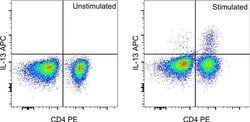
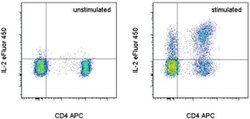
- Applications Tested: This RM9A4 antibody has been tested by intracellular staining followed by flow cytometric analysis of cultured mouse splenocytes
- This can be used at less than or equal to 0.06 μg per test
- A test is defined as the amount (μg) of antibody that will stain a cell sample in a final volume of 100 μL
- Interleukin 9 (IL-9) is produced by activated T helper 2 (Th2) lymphocytes
- IL-9 regulates many cell types involved in classical Th2-associated asthma responses, including B and T lymphocytes, mast cells, eosinophils, and epithelial cells
- The mouse IL-9 cDNA encodes a 144 amino acid precursor protein with an 18 amino acid signal peptide that is cleaved to form the mature cysteine-rich protein with a molecular mass of 14 kDa
- Native mouse IL-9 is heavily glycosylated
- Recently, TGF beta has been reported to play an important role in the differentiation of IL-17-producing T helper cells and inducible regulatory T cells by reprogramming Th2 cells to secrete IL-9, thereby driving the differentiation of Th9 cells directly.