CD14 Monoclonal Antibody (Sa2-8), PE-Cyanine7, eBioscience™, Invitrogen™
Manufacturer: Invitrogen
Select a Size
| Pack Size | SKU | Availability | Price |
|---|---|---|---|
| Each of 1 | 50-112-8840-Each-of-1 | In Stock | ₹ 30,794.00 |
50-112-8840 - Each of 1
In Stock
Quantity
1
Base Price: ₹ 30,794.00
GST (18%): ₹ 5,542.92
Total Price: ₹ 36,336.92
Antigen
CD14
Classification
Monoclonal
Concentration
0.2 mg/mL
Formulation
PBS with 0.09% sodium azide; pH 7.2
Gene Accession No.
P10810
Gene Symbols
Cd14
Purification Method
Affinity chromatography
Regulatory Status
RUO
Gene ID (Entrez)
12475
Content And Storage
4° C, store in dark, DO NOT FREEZE!
Form
Liquid
Applications
Flow Cytometry
Clone
Sa2-8
Conjugate
PE-Cyanine7
Gene
Cd14
Gene Alias
CD 14; CD14; CD14 antigen; CD14 molecule; cd14 monocyte; lipopolysaccharide receptor; lipoprotein receptor; LPSR antibody; monocyte differentiation antigen CD14; Monocyte differentiation antigen CD14, membrane-bound form; Monocyte differentiation antigen CD14, urinary form; monocyte differentiation antigen CD14; LOW QUALITY PROTEIN: monocyte differentiation antigen CD14; myeloid cell-specific leucine-rich glycoprotein; myeloid membrane glycoprotein precursor; sCD14; soluble CD14
Host Species
Rat
Quantity
100 μg
Primary or Secondary
Primary
Target Species
Mouse
Product Type
Antibody
Isotype
IgG2a κ
Related Products


Description
- Description: The Sa2-8 monoclonal antibody reacts with mouse CD14, a 53-55 kDa GPI-linked glycoprotein
- CD14 is a receptor for the complexes of LPS and LBP (LPS-Binding Protein) and is shown to associate with Toll-Like Receptor 4 (TLR4) and participate in the signaling and cellular response to bacterial LPS
- In mouse, CD14 is expressed on the surface of macrophages and under certain conditions is also found in the serum in a secreted form
- Sa2-8 has weak antagonistic activity (in NF-kappaB activation or TNF alpha production with LPS stimulation)
- Applications Reported: This Sa2-8 antibody has been reported for use in flow cytometric analysis
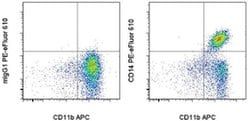
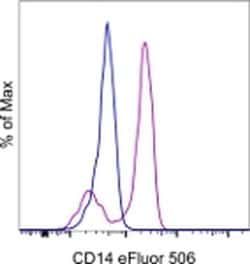
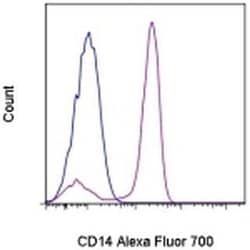
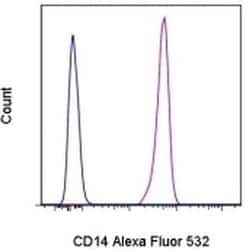
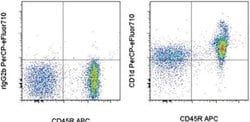
- Applications Tested: This Sa2-8 antibody has been tested by flow cytometric analysis of mouse thioglycolate-elicited peritoneal exudate cells
- This can be used at less than or equal to 1 μg per test
- A test is defined as the amount (μg) of antibody that will stain a cell sample in a final volume of 100 μL
- Cell number should be determined empirically but can range from 10^5 to 10^8 cells/test
- It is recommended that the antibody be carefully titrated for optimal performance in the assay of interest
- Light sensitivity: This tandem dye is sensitive photo-induced oxidation
- Please protect this vial and stained samples from light
- Fixation: Samples can be stored in IC Fixation Buffer (cat
- 00-8222) (100 μL cell sample + 100 μL IC Fixation Buffer) or 1-step Fix/Lyse Solution (cat
- CD14 is a 55 kDa GPI-anchored glycoprotein that is constitutively expressed on the surface of mature monocytes, macrophages, and neutrophils
- CD14 also serves as a multifunctional lipopolysaccharide receptor, and is released to the serum both as a secreted and enzymatically cleaved GPI-anchored form
- CD14 binds lipopolysaccharide molecule in a reaction catalyzed by lipopolysaccharide-binding protein (LBP), an acute phase serum protein
- The soluble sCD14 can discriminate slight structural differences between lipopolysaccharides and is important for neutralization of serum allochthonous lipopolysaccharides by reconstituted lipoprotein particles
- Further, CD14 has been shown to bind apoptotic cells, and can affect allergic, inflammatory and infectious processes
- Alternative splicing results in multiple transcript variants encoding the same CD14 isoform
- Diseases associated with CD14 dysfunction include mycobacterium chelonae infection and Croup.