CD14 Monoclonal Antibody (TuK4), Qdot™ 655, Invitrogen™
Manufacturer: Invitrogen
Select a Size
| Pack Size | SKU | Availability | Price |
|---|---|---|---|
| Each of 1 | 50-113-8145-Each-of-1 | In Stock | ₹ 60,876.00 |
50-113-8145 - Each of 1
In Stock
Quantity
1
Base Price: ₹ 60,876.00
GST (18%): ₹ 10,957.68
Total Price: ₹ 71,833.68
Antigen
CD14
Classification
Monoclonal
Conjugate
Qdot 655
Gene
Cd14
Gene Alias
CD 14; CD14; CD14 antigen; CD14 molecule; cd14 monocyte; lipopolysaccharide receptor; lipoprotein receptor; LPSR antibody; monocyte differentiation antigen CD14; Monocyte differentiation antigen CD14, membrane-bound form; Monocyte differentiation antigen CD14, urinary form; monocyte differentiation antigen CD14; LOW QUALITY PROTEIN: monocyte differentiation antigen CD14; myeloid cell-specific leucine-rich glycoprotein; myeloid membrane glycoprotein precursor; sCD14; soluble CD14
Host Species
Mouse
Purification Method
purified
Regulatory Status
RUO
Gene ID (Entrez)
929
Content And Storage
4° C, store in dark
Form
Liquid
Applications
Flow Cytometry
Clone
TuK4
Formulation
0.05M borate with 1M betaine and 0.05% sodium azide; pH 8.3
Gene Accession No.
P08571
Gene Symbols
Cd14
Immunogen
Tthe CD14 antigen
Quantity
100 μL
Primary or Secondary
Primary
Target Species
Human
Product Type
Antibody
Isotype
IgG2a
Related Products

Description
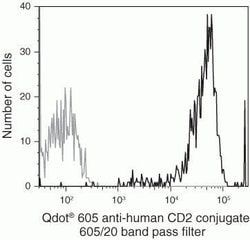
- Qdot™ Antibody (Ab) conjugates possess a bright fluorescence emission that makes them well suited for the detection of low-abundance extracellular proteins
- Approximately the same size as R-phycoerythrin (R-PE) and compatible with existing organic fluorophore conjugates, Qdot™ Ab conjugates can be excited with any wavelength below their emission maximum, but are best excited by UV or violet light
- The narrow, symmetric emission profiles of Qdot Ab conjugates allow for minimal compensation when using a single excitation source, and the very long stoke shifts enable better, more efficient multicolor assays using the 405 nm violet laser
- Available in multiple colors for use in flow cytometry, these advantages make Qdot Ab conjugates powerful tools for antibody labeling and staining
- Staining: Stain cells in any standard staining buffer, such as phosphate buffered saline (PBS) with 1% bovine serum albumin (BSA)
- We recommend analysis of cells within 18 hours of staining
- If dilute reagent is used, dilute only the quantity of reagent to be used within one day
- Qdot Ab conjugates may be mixed with other antibodies, but use the diluted conjugates on the day of dilution
- Qdot Ab conjugates can be used for surface staining applications with most conventional sample preparation reagents, such as Cal-Lyse™ Lysing Solution and FIX & PERM™ reagents, with minimal effect on fluorescence
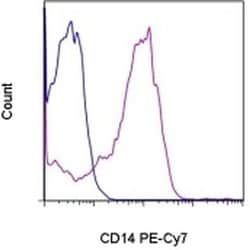
- CD14 is a 55 kDa GPI-anchored glycoprotein that is constitutively expressed on the surface of mature monocytes, macrophages, and neutrophils
- CD14 also serves as a multifunctional lipopolysaccharide receptor, and is released to the serum both as a secreted and enzymatically cleaved GPI-anchored form
- CD14 binds lipopolysaccharide molecule in a reaction catalyzed by lipopolysaccharide-binding protein (LBP), an acute phase serum protein
- The soluble sCD14 can discriminate slight structural differences between lipopolysaccharides and is important for neutralization of serum allochthonous lipopolysaccharides by reconstituted lipoprotein particles
- Further, CD14 has been shown to bind apoptotic cells, and can affect allergic, inflammatory and infectious processes
- Alternative splicing results in multiple transcript variants encoding the same CD14 isoform
- Diseases associated with CD14 dysfunction include mycobacterium chelonae infection and Croup.