50-115-39
CD43 Monoclonal Antibody (eBioR2/60), Biotin, eBioscience™, Invitrogen™
Manufacturer: Fischer Scientific
The price for this product is unavailable. Please request a quote
Antigen
CD43
Classification
Monoclonal
Concentration
0.5 mg/mL
Formulation
PBS with 0.09% sodium azide; pH 7.2
Gene Accession No.
P15702
Gene Symbols
Spn
Purification Method
Affinity chromatography
Regulatory Status
RUO
Gene ID (Entrez)
20737
Content And Storage
4° C, store in dark, DO NOT FREEZE!
Form
Liquid
Applications
Flow Cytometry
Clone
eBioR2/60
Conjugate
Biotin
Gene
Spn
Gene Alias
CD43, GALGP, GPL115, LSN, galactoglycoprotein, leukocyte sialoglycoprotein, leukosialin, sialophorin gpL115, leukosialin, CD43
Host Species
Rat
Quantity
50 μg
Primary or Secondary
Primary
Target Species
Mouse
Product Type
Antibody
Isotype
IgM
Related Products
Description
- Description: The eBioR2/60 monoclonal antibody reacts with mouse CD43, also known as leukosialin and sialophorin
- CD43 has glycoforms of approximately 115 and 130 kDa, and is expressed by an early B cell subset in BM, thymocytes and mature T cells, NK cells, myeloid lineage cells and platelets
- CD43 is reported to bind to CD54 and play a role in adhesion and B cell survival
- While the S7 and 1B11 monoclonal antibody clones detect only certain isoforms of CD43, data suggests that R2/60 detects the expression of both isoforms
- It has been demonstrated that R2/60 stains the majority of CD4+ and CD8+ splenocytes, as well as a significant population of CD19+ splenocytes
- However, the clones S7 and 1B11 stain only CD4+ and CD8+, or CD19+ splenocytes, respectively
- This suggests that S7 and 1B11 recognize distinct epitopes which are differentially expressed by splenic B and T cells, whereas R2/60 recognizes an epitope shared by both isoforms of CD43
- Applications Reported: This eBioR2/60 antibody has been reported for use in flow cytometric analysis
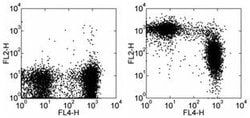
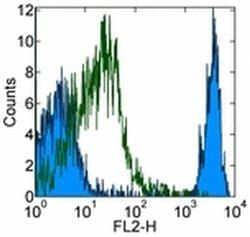
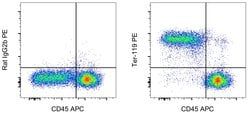
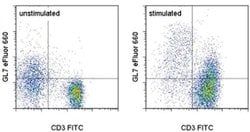
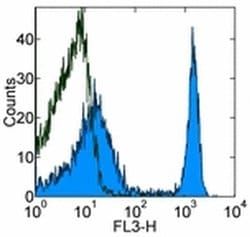
- Applications Tested: This eBioR2/60 antibody has been tested by flow cytometric analysis of mouse splenocytes
- This can be used at less than or equal to 0.5 μg per test
- A test is defined as the amount (μg) of antibody that will stain a cell sample in a final volume of 100 μL
- Cell number should be determined empirically but can range from 10^5 to 10^8 cells/test
- CD43 (leukosialin, sialophorin) is a transmembrane mucin-like protein with high negative charge, expressed on the surface of most hematopoietic cells
- CD43 contributes to a repulsive barrier that interferes with cellular adhesion, however, in certain cases also promotes leukocyte aggregation
- By interaction with actin-binding proteins ezrin and moesin CD43 plays a regulatory role in remodeling T-cell morphology and regulates cell-cell interactions during lymphocyte traffic
- CD43 signaling both enhances LFA-1 adhesiveness and counteracts LFA-1 induction via other receptors
- Expression of CD43 causes induction of functionally active tumor suppressor p53 protein, but in case of p53 and ARF deficiency CD43 promotes tumor proliferation and viability
- CD43 appears to be an important modulator of leukocyte functions
- Diseases associated with CD43 dysfunction include Wiscott-Aldrich Syndrome and Adenoid Basal Cell Carcinoma.