CD171 Monoclonal Antibody (eBio5G3 (5G3)), eBioscience™, Invitrogen™
Manufacturer: Invitrogen
Select a Size
| Pack Size | SKU | Availability | Price |
|---|---|---|---|
| Each of 1 | 50-129-40-Each-of-1 | In Stock | ₹ 27,234.00 |
50-129-40 - Each of 1
In Stock
Quantity
1
Base Price: ₹ 27,234.00
GST (18%): ₹ 4,902.12
Total Price: ₹ 32,136.12
Antigen
CD171
Classification
Monoclonal
Concentration
0.5 mg/mL
Formulation
PBS with 0.09% sodium azide; pH 7.2
Gene Accession No.
P32004
Gene Symbols
L1CAM
Purification Method
Affinity chromatography
Regulatory Status
RUO
Gene ID (Entrez)
3897
Content And Storage
4° C
Form
Liquid
Applications
Flow Cytometry, Immunohistochemistry (Frozen), Immunoprecipitation, Western Blot
Clone
eBio5G3 (5G3)
Conjugate
Unconjugated
Gene
L1CAM
Gene Alias
antigen identified by monoclonal antibody R1; CAML1; CD 171; CD171; CD171 molecule; HSAS; HSAS1; Hyd; L1; L1 cell adhesion molecule; L1CAM; MASA; MIC5; N-CAM L1; NCAML1; N-CAML1; N-CAM-L1; NCAM-L1; Nerve-growth factor-inducible large external glycoprotein; neural cell adhesion molecule L1; NILE; S10; sCD171; sL1 CAM; sL1CAM; soluble CD 171; soluble CD171; soluble L1 CAM; soluble L1CAM; SPG1
Host Species
Mouse
Quantity
100 μg
Primary or Secondary
Primary
Target Species
Human
Product Type
Antibody
Isotype
IgG2a
Related Products



Description
- Description: The monoclonal antibody eBio5G3 recognizes CD171 also known as neural cell adhesion molecule L1
- CD171 is a member of the Ig superfamily containing 6 extracellular Ig domains and five fibronectin type III-like repeats
- CD171 has been shown to function as a cell adhesion molecule mediating homotypic and heterotypic cell-cell interactions in neuronal myelination, neurite outgrowth and regeneration
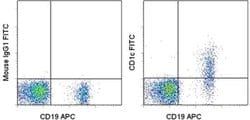
- Expression of CD171 has been found on monocytes and mature monocytic-derived and follicular DCs, a minor subset of lymphocytes in addition to that found on neuronal tissue and some tumor cells lines
- Expression of CD171 on tumors is thought to contribute to tumor progression
- Epitope of eBio5G3 is in amino-terminal Ig-like domain
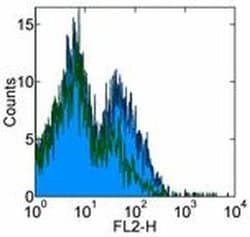
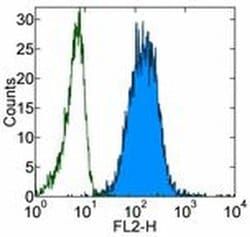
- Applications Reported: This eBio5G3 (5G3) antibody has been reported for use in flow cytometric analysis, immunoprecipitation, immunoblotting (WB) under nonreducing conditions, and immunohistology staining of frozen tissue sections
- Applications Tested: This eBio5G3 (5G3) antibody has been tested by flow cytometric of tumor cell line Panc-1
- This can be used at less than or equal to 0.25 μg per test
- A test is defined as the amount (μg) of antibody that will stain a cell sample in a final volume of 100 μL
- Cell number should be determined empirically but can range from 10^5 to 10^8 cells/test
- It is recommended that the antibody be carefully titrated for optimal performance in the assay of interest
- L1CAM/CD171 is an axonal glycoprotein belonging to the immunoglobulin supergene family
- The ectodomain, consisting of several immunoglobulin-like domains and fibronectin-like repeats (type III), is linked via a single transmembrane sequence to a conserved cytoplasmic domain
- This cell adhesion molecule plays an important role in nervous system development, including neuronal migration and differentiation
- Mutations in the gene cause three X-linked neurological syndromes known by the acronym CRASH (corpus callosum hypoplasia, retardation, aphasia, spastic paraplegia and hydrocephalus)
- Alternative splicing of a neuron-specific exon is thought to be functionally relevant.