MCL-1 Monoclonal Antibody (Ab22), eBioscience™, Invitrogen™
Manufacturer: Invitrogen
Select a Size
| Pack Size | SKU | Availability | Price |
|---|---|---|---|
| Each of 1 | 50-135-17-Each-of-1 | In Stock | ₹ 42,720.00 |
50-135-17 - Each of 1
In Stock
Quantity
1
Base Price: ₹ 42,720.00
GST (18%): ₹ 7,689.60
Total Price: ₹ 50,409.60
Antigen
MCL-1
Classification
Monoclonal
Concentration
0.5 mg/mL
Formulation
PBS with 0.09% sodium azide; pH 7.2
Gene Accession No.
Q07820
Gene Symbols
MCL1
Purification Method
Affinity chromatography
Regulatory Status
RUO
Gene ID (Entrez)
4170
Content And Storage
4° C
Form
Liquid
Applications
Immunocytochemistry, Western Blot
Clone
Ab22
Conjugate
Unconjugated
Gene
MCL1
Gene Alias
AW556805; BCL2 family apoptosis regulator; BCL2L3; bcl2-L-3; Bcl-2-like protein 3; bcl-2-related protein EAT/mcl1; EAT; Induced myeloid leukemia cell differentiation protein Mcl-1; induced myeloid leukemia cell differentiation protein Mcl-1 homolog; Mcl1; Mcl-1; mcl1/EAT; MCL1-ES; MCL1L; MCL1S; MCL-1S; MGC104264; MGC1839; myeloid cell leukemia 1; myeloid cell leukemia ES; myeloid cell leukemia sequence 1; myeloid cell leukemia sequence 1 (BCL2-related); TM
Host Species
Mouse
Quantity
100 μg
Primary or Secondary
Primary
Target Species
Human
Product Type
Antibody
Isotype
IgG1 κ
Related Products



Description
- Description: This Ab22 monoclonal antibody reacts with the human myeloid cell leukemia-1 (Mcl-1) protein
- This 40 kDa Bcl-2 family member is expressed in B and T cells, macrophages, neutrophils, and hematopoietic stem cells
- Mcl-1 is also expressed in non-immune cells such as fibroblasts, epithelial cells, neuroendocrine cells, chondrocytes, and hepatocytes
- Reportedly induced by growth factors and cytokines in normal cells, Mcl-1 expression of Mcl-1 can be dysregulated in various leukemias and cancer
- Mcl-1 mediates cell survival and proliferation by sequestering the pro-apoptotic Bcl-2 proteins Bak, Bax, and Bim
- This protein is also involved in germinal center and memory B cell formation, as well as in myeloid and early lymphoid differentiation
- Finally, Mcl-1 activity and dimerization with Bcl-2 family members is dependent on serine and threonine phosphorylation
- Applications Reported: This Ab22 antibody has been reported for use in immunoblotting (WB) and immunocytochemistry (ICC)
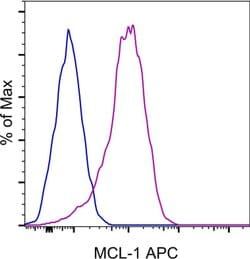
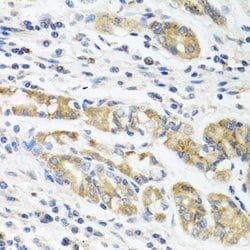
- Applications Tested: This Ab22 antibody has been tested by immunocytochemistry on fixed and permeabilized MCF7 cells at less than or equal to 5 μg/mL
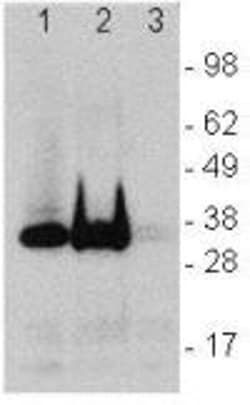
- This Ab22 has also been tested by western blot of reduced Jurkat cell lysate and can be used at 5 μg/mL
- It is recommended that the antibody be carefully titrated for optimal performance in the assay of interest
- Purity: Greater than 90%, as determined by SDS-PAGE
- MCL1 (Myeloid cell leukemia-1) belongs to the Bcl-2 family and is involved in programing, differentiation and concomitant maintenance of cell viability, but not of proliferation
- Isoform 1 of MCL1 inhibits apoptosis while isoform 2 promotes it
- The carboxy terminal of MCL1 and bcl-2 share significant sequence homology
- Expression of MCL1 is increased upon exposure of ML-1 cells to various types of DNA damaging agents (e.g
- ionizing radiation, μgtraviolet radiation, and alkylating drugs) along with increases in GADD45 and Bax and a decrease in bcl-2
- Enhanced expression of MCL1, prominently associated with mitochondria, complements the continued expression of bcl-2 in ML-1 cells undergoing differentiation
- Like bcl-2, MCL1 has the capacity to promote cell viability under conditions that otherwise cause apoptosis
- While the mechanism by which MCL1 inhibits apoptosis is not known, it is thought that it may heterodimerize and neutralize pro-apoptotic members of the Bcl-2 family such as Bim or Bak
- MCL1 was originally identified in differentiating myeloid cells, but has since been shown to be expressed in multiple cell types
- MCL1 is essential for embryogenesis and for the development and maintenance of B and T lymphocytes in animals
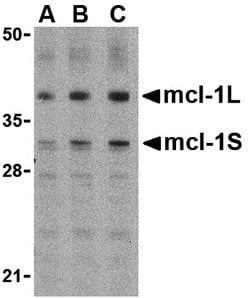
- MCL1 exists as at least two distinct isoforms designated MCL1L and MCL1S
- In marked contrast to the larger isoform of MCL1, overexpression of MCL1S promotes cell death.