CD137 (4-1BB) Monoclonal Antibody (17B5), Functional Grade, eBioscience™, Invitrogen™
Manufacturer: Invitrogen
Select a Size
| Pack Size | SKU | Availability | Price |
|---|---|---|---|
| Each of 1 | 50-144-62-Each-of-1 | In Stock | ₹ 33,909.00 |
50-144-62 - Each of 1
In Stock
Quantity
1
Base Price: ₹ 33,909.00
GST (18%): ₹ 6,103.62
Total Price: ₹ 40,012.62
Antigen
CD137 (4-1BB)
Classification
Monoclonal
Concentration
1 mg/mL
Formulation
PBS with no preservative; pH 7.2
Gene Accession No.
P20334
Gene Symbols
TNFRSF9
Purification Method
Affinity chromatography
Regulatory Status
RUO
Gene ID (Entrez)
21942
Content And Storage
4° C
Form
Liquid
Applications
Flow Cytometry, Functional Assay
Clone
17B5
Conjugate
Functional Grade
Gene
TNFRSF9
Gene Alias
4 1 BB; 41BB; 4-1BB; 4-1BB ligand receptor; A930040I11Rik; AA408498; AI325004; Cd137; CD137 antigen; CDw137; EGK_00183; homolog of mouse 4-1BB; ILA; induced by lymphocyte activation (ILA); interleukin-activated receptor, homolog of mouse Ly63; Ly63; receptor protein 4-1BB; s4 1 BB; s4 1BB; s41BB; sCD137; secreted CD137 antigen; soluble 4 1 BB; soluble 4 1BB; soluble 41BB; soluble CD137; T cell antigen ILA; T-cell antigen 4-1BB; T-cell antigen 4-1BB homolog; T-cell antigen ILA; TNF receptor superfamily member 9; TNFRSF9; Tumor necrosis factor receptor superfamily member 9; tumor necrosis factor receptor superfamily, member 9
Host Species
Syrian Hamster
Quantity
500 μg
Primary or Secondary
Primary
Target Species
Mouse
Product Type
Antibody
Isotype
IgG
Related Products


Description
- Description: The 17B5 monoclonal antibody reacts with mouse CD137, also known as 4-1BB, a member of the TNFR superfamily
- CD137 is expressed as monomers, dimers, and tetramers on the surface of activated T cells around day 4-6 after activation through the TCR complex
- Interaction of CD137 with its ligand, 4-1BBL, is reported to deliver a costimulatory signal important in the T-APC interaction
- Recent data suggests CD317 is expressed on Tregs and may play a role in their proliferation
- The monoclonal antibody 17B5 has strong antagonistic effect in in vitro functional assays
- Applications Reported: This 17B5 antibody has been reported for use in flow cytometric analysis and functional assays
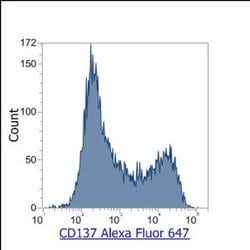
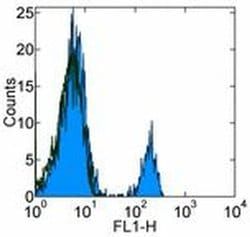
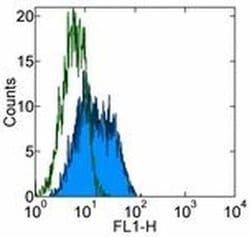
- Applications Tested: The 17B5 antibody has been tested by flow cytometric analysis of activated mouse splenocytes cultures
- This can be used at less than or equal to 0.5 μg per test
- A test is defined as the amount (μg) of antibody that will stain a cell sample in a final volume of 100 μL
- Cell number should be determined empirically but can range from 10^5 to 10^8 cells/test
- It is recommended that the antibody be carefully titrated for optimal performance in the assay of interest
- Storage and handling: Use in a sterile environment
- Filtration: 0.2 μm post-manufacturing filtered
- Purity: Greater than 90%, as determined by SDS-PAGE
- Endotoxin Level: Less than 0.001 ng/μg antibody, as determined by LAL assay
- Aggregation: Less than 10%, as determined by HPLC
- CD137, also known as TNFRSF9 or 4-1BB, is an inducible costimulatory molecule expressed mainly on activated T cells
- Its ligand, known as 4-1BBL, is expressed on activated macrophages, mature B cells, hematopoietic stem cells, and myeloid progenitor cells
- CD137 signaling leads to maintaining the survival of activated T cells and CD8+ memory T cells, and clonal expansion of T cells, but also to suppressing myelopoiesis and dendritic cell development
- Triggered CD137 induces a cytokine release profile regulating peripheral monocyte survival
- Soluble forms of CD137 may provide negative control mechanism for some immune responses.