50-155-6886
PARC/H7-AP1 Rabbit anti-Human, Polyclonal, Bethyl Laboratories
Manufacturer: Bethyl Laboratories, Inc
Select a Size
| Pack Size | SKU | Availability | Price |
|---|---|---|---|
| Each of 1 | 50-155-6886-Each-of-1 | In Stock | ₹ 43,546.81 |
50-155-6886 - Each of 1
In Stock
Quantity
1
Base Price: ₹ 43,546.81
GST (18%): ₹ 7,838.426
Total Price: ₹ 51,385.236
Antigen
PARC/H7-AP1
Classification
Polyclonal
Conjugate
Unconjugated
Gene
CUL9
Gene Alias
H7AP1, PARC, RP3-330M21.2; CUL-9; UbcH7-associated protein 1; cullin-9; p53-associated parkin-like cytoplasmic protein; parkin-like cytoplasmic p53 binding protein
Host Species
Rabbit
Purification Method
Antigen affinity chromatography
Regulatory Status
RUO
Gene ID (Entrez)
23113
Content And Storage
4° C
Form
Liquid
Applications
Immunoprecipitation, Western Blot
Concentration
1 mg/ml
Formulation
phosphate, tris citrate with 0.09% sodium azide; pH 7-8
Gene Accession No.
Q8IWT3
Gene Symbols
CUL9
Immunogen
Between 900 and 950
Quantity
100 μL
Primary or Secondary
Primary
Target Species
Human
Product Type
Antibody
Isotype
IgG
Related Products


Description
- The recommended shelf life for this product is 1 year from date of receipt
- The continued localization of p53 to the nucleus is essential for its function as a tumor suppressor
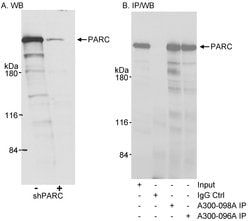
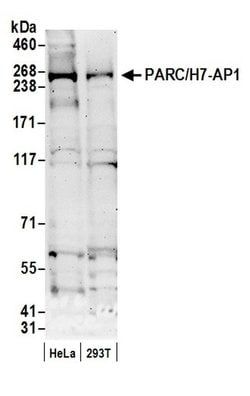
- PARC, a large, Parkin-like ubiquitin ligase has recently been identified as a cytoplasmic anchor protein in p53-associated protein complexes
- In the absence of stress, PARC inactivation results in nuclear localization of p53 and activation of p53-dependent apoptosis, while overexpression of this protein promoted cytoplasmic sequestration of p53
- Surprisingly, PARC knockout mice were viable and exhibited no obvious phenotype, suggesting that other proteins, such as the highly related cullin family of E3 ubiquitin ligases, may perform similar functions in the absence of PARC
- Additionally, it has been suggested that p53 binding to PARC may serve to control PARC function.