50-155-7305
Caper Rabbit anti-Human, Polyclonal, Bethyl Laboratories
Manufacturer: Bethyl Laboratories, Inc
Select a Size
| Pack Size | SKU | Availability | Price |
|---|---|---|---|
| Each of 1 | 50-155-7305-Each-of-1 | In Stock | ₹ 43,546.81 |
50-155-7305 - Each of 1
In Stock
Quantity
1
Base Price: ₹ 43,546.81
GST (18%): ₹ 7,838.426
Total Price: ₹ 51,385.236
Antigen
Caper
Classification
Polyclonal
Conjugate
Unconjugated
Gene
RBM39
Gene Alias
CAPER, CAPERalpha, FSAP59, HCC1, RNPC2, RNA-binding protein 39, RNA-binding region (RNP1, RRM) containing 2, coactivator of activating protein-1 and estrogen receptors, functional spliceosome-associated protein 59, hepatocellular carcinoma protein 1, splicing factor HCC1
Host Species
Rabbit
Purification Method
Antigen affinity chromatography
Regulatory Status
RUO
Gene ID (Entrez)
9584
Content And Storage
4° C
Form
Liquid
Applications
Immunohistochemistry, Immunoprecipitation, Western Blot
Concentration
1 mg/ml
Formulation
PBS with 0.09% sodium azide
Gene Accession No.
Q14498
Gene Symbols
RBM39
Immunogen
Between 325 and 375
Quantity
100 μL
Primary or Secondary
Primary
Target Species
Human
Product Type
Antibody
Isotype
IgG
Related Products




Description
- The recommended shelf life for this product is 1 year from date of receipt
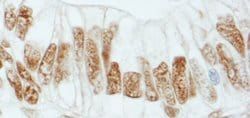
- Application Note: For IHC, epitope retrieval with citrate buffer pH 6.0 is recommended for FFPE tissue sections
- Based on 100% sequence identity, this antibody is predicted to react with Mouse and Orangutan The protein encoded by this gene is an RNA binding protein and possible splicing factor
- The encoded protein is found in the nucleus, where it colocalizes with core spliceosomal proteins
- Studies of a mouse protein with high sequence similarity to this protein suggest that this protein may act as a transcriptional coactivator for JUN/AP-1 and estrogen receptors
- Multiple transcript variants encoding different isoforms have been observed for this gene.