50-157-1360
NCOA2/SRC2 Polyclonal Antibody, Bethyl Laboratories
Manufacturer: Fischer Scientific
Select a Size
| Pack Size | SKU | Availability | Price |
|---|---|---|---|
| Each of 1 | 50-157-1360-Each-of-1 | In Stock | ₹ 12,384.35 |
50-157-1360 - Each of 1
In Stock
Quantity
1
Base Price: ₹ 12,384.35
GST (18%): ₹ 2,229.183
Total Price: ₹ 14,613.533
Antigen
NCOA2/SRC2
Classification
Polyclonal
Formulation
TBS with 0.1% BSA and 0.09% sodium azide
Gene Accession No.
Q15596
Gene Symbols
NCOA2
Immunogen
Between 1400 and C-term
Quantity
10 μL
Primary or Secondary
Primary
Target Species
Human
Product Type
Antibody
Isotype
IgG
Applications
Immunohistochemistry
Conjugate
Unconjugated
Gene
NCOA2
Gene Alias
Glucocorticoid Receptor Interacting Protein, Transcription Intermediary Factor 2, TIF 2
Host Species
Rabbit
Purification Method
Antigen affinity chromatography
Regulatory Status
RUO
Gene ID (Entrez)
10499
Content And Storage
4° C
Form
Liquid
Related Products

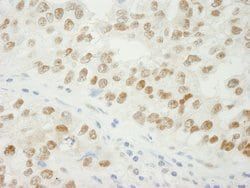
Description
- The recommended shelf life for this product is 1 year from date of receipt
- Based on 100% sequence identity, this antibody is predicted to react with Monkey, Gorilla, Chimpanzee, Northern white-cheeked gibbon and White-tufted-ear marmoset SRC2 (steroid receptor coactivator 2), also known as nuclear receptor coactivator2, NCOA2 or TIF2, aids in the function of nuclear hormone receptors
- Nuclear hormone receptors are conditional transcription factors that play important roles in various aspects of cell growth, development, and homeostasis by controlling expression of specific genes
- Members of the nuclear hormone receptor superfamily, which includes the 5 steroid receptors and class II nuclear receptors (see below), are structurally characterized by 3 distinct domains: an N-terminal transcriptional activation domain, a central DNA-binding domain, and a C-terminal hormone-binding domain
- Before the binding of hormone, steroid receptors, which are sometimes called class I of the nuclear hormone receptor family, remain inactive in a complex with heat-shock protein-90 (MIM 140571) and other stress family proteins
- Binding of hormone induces critical conformational changes in steroid receptors that cause them to dissociate from the inhibitory complex, bind as homodimers to specific DNA enhancer elements associated with target genes, and modulate that gene's transcription
- After binding to enhancer elements, transcription factors require transcriptional coactivator proteins to mediate their stimulation of transcription initiation (Hong et al., 1997 [PubMed 9111344]).