50-166-8603
FOLR2 Mouse anti-Human, Clone: OTI5B1, lyophilized, TrueMAB™
Manufacturer: OriGene
Select a Size
| Pack Size | SKU | Availability | Price |
|---|---|---|---|
| Each of 1 | 50-166-8603-Each-of-1 | In Stock | ₹ 60,342.00 |
50-166-8603 - Each of 1
In Stock
Quantity
1
Base Price: ₹ 60,342.00
GST (18%): ₹ 10,861.56
Total Price: ₹ 71,203.56
Antigen
FOLR2
Classification
Monoclonal
Conjugate
Unconjugated
Gene
FOLR2
Gene Alias
BETA-HFR, FBP, FBP/PL-1, FR-BETA, FR-P3
Host Species
Mouse
Purification Method
Affinity Chromatography
Regulatory Status
RUO
Gene ID (Entrez)
2350
Content And Storage
-20° C, Avoid Freeze/Thaw Cycles
Form
Lyophilized
Applications
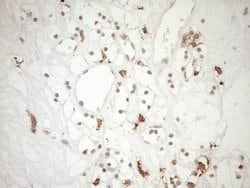
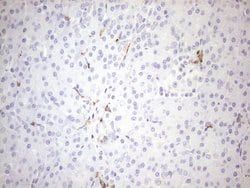
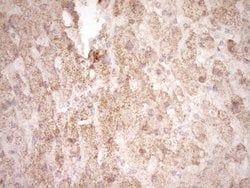
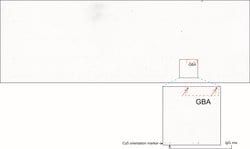
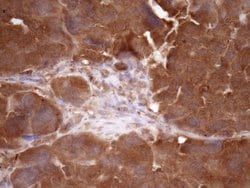
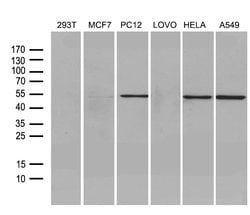
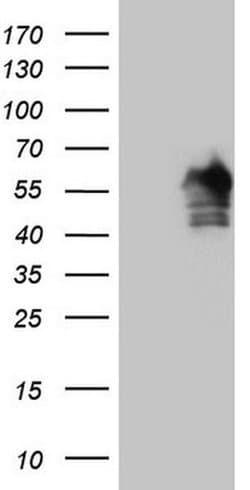
Immunohistochemistry (Paraffin), Western Blot
Clone
OTI5B1
Formulation
PBS with 8% trehalose and no preservative; pH 7.3
Gene Accession No.
P14207
Gene Symbols
FOLR2
Immunogen
Human recombit protein fragment corresponding to amino acids 20-221 of human FOLR2 produced in E.coli.
Quantity
100 μg
Primary or Secondary
Primary
Target Species
Human
Product Type
Antibody
Isotype
IgG2a
Related Products

Description
- Reconstitute with PBS (pH 7.3) and recommend to perform another round of desalting process using Product No
- 7KMWCO FOLR2 is a member of the folate receptor (FOLR) family, and these genes exist in a cluster on chromosome 11
- Members of this gene family have a high affinity for folic acid and for several reduced folic acid derivatives, and they mediate delivery of 5-methyltetrahydrofolate to the interior of cells
- This protein has a 68% and 79% sequence homology with the FOLR1 and FOLR3 proteins, respectively
- Although this protein was originally thought to be specific to placenta, it can also exist in other tissues, and it may play a role in the transport of methotrexate in synovial macrophages in rheumatoid arthritis patients.