50-167-5930
CRYAA Mouse anti-Human, Clone: OTI2C3, liquid, TrueMAB™
Manufacturer: OriGene
Select a Size
| Pack Size | SKU | Availability | Price |
|---|---|---|---|
| Each of 1 | 50-167-5930-Each-of-1 | In Stock | ₹ 20,470.00 |
50-167-5930 - Each of 1
In Stock
Quantity
1
Base Price: ₹ 20,470.00
GST (18%): ₹ 3,684.60
Total Price: ₹ 24,154.60
Antigen
CRYAA
Classification
Monoclonal
Concentration
1 mg/mL
Formulation
PBS with 1% BSA, 50% glycerol and 0.02% sodium azide
Gene Accession No.
P02489
Gene Symbols
CRYAA
Immunogen
Full length human recombit protein of human CRYAA produced in HEK293T cell.
Quantity
30 μL
Primary or Secondary
Primary
Target Species
Human
Product Type
Antibody
Isotype
IgG2b
Applications
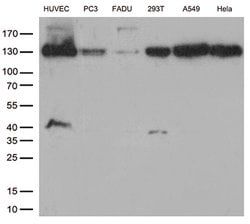
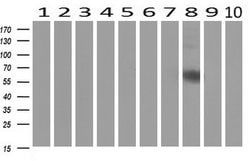
Immunohistochemistry (Paraffin), Western Blot
Clone
OTI2C3
Conjugate
Unconjugated
Gene
CRYAA
Gene Alias
CRYA1, CTRCT9, HSPB4
Host Species
Mouse
Purification Method
Affinity Chromatography
Regulatory Status
RUO
Gene ID (Entrez)
1409
Content And Storage
-20° C, Avoid Freeze/Thaw Cycles
Form
Liquid
Related Products


Description
- Lens proteins consist almost entirely of crystallins (about 95%)
- Crystallins are also found vertebrate skeletal muscle tissue
- In the lens, their structural function is to assist in maintaining the proper refractive index of the lens
- The mammalian lens contains 3 major classes of crystallins: alpha, beta, and gamma
- Alpha-crystallin is the largest of the crystallins and is composed of 2 primary gene products-alpha-A and alpha-B
- There are at least 5 different proteins comprising the beta-crystallins
- The gamma-crystallins are monomeric, but there are at least 5 gamma crystallins identified in bovine and rat lens
- Alpha-Crystallin comprises 40% of total lens protein composition
- In addition to maintaining proper refractive index, it also functions in a chaperone like manner by preventing the formation of aggregates possibly leading to cataract formation
- It is believed that the phosphorylated states of the alpha-crystallin occur in response to cellular stress and may serve a structural control function and play a role in protein maintece
- Alpha-B crystallin has been linked to Alexander′s disease where it accumulates in brain cells of those afflicted.