CD200 Receptor Monoclonal Antibody (OX110), PerCP-eFluor™ 710, eBioscience™, Invitrogen™
Manufacturer: Invitrogen
Select a Size
| Pack Size | SKU | Availability | Price |
|---|---|---|---|
| Each of 1 | 50-245-906-Each-of-1 | In Stock | ₹ 26,789.00 |
50-245-906 - Each of 1
In Stock
Quantity
1
Base Price: ₹ 26,789.00
GST (18%): ₹ 4,822.02
Total Price: ₹ 31,611.02
Antigen
CD200 Receptor
Classification
Monoclonal
Concentration
0.2 mg/mL
Formulation
PBS with 0.09% sodium azide; pH 7.2
Gene Accession No.
Q9ES57
Gene Symbols
CD200R1
Purification Method
Affinity chromatography
Regulatory Status
RUO
Gene ID (Entrez)
57781
Content And Storage
4° C, store in dark, DO NOT FREEZE!
Form
Liquid
Applications
Flow Cytometry
Clone
OX110
Conjugate
PerCP-eFluor 710
Gene
CD200R1
Gene Alias
antigen identified by monoclonal antibody MRC OX-2 receptor; CD200 cell surface glycoprotein receptor; CD200 R1; CD200 receptor 1; CD200R; Cd200r1; Cell surface glycoprotein CD200 receptor 1; cell surface glycoprotein OX2 receptor 1; cell surface glycoprotein receptor CD200; CRTR2; HCRTR2; MOX2 receptor; MOX2R; Orexin receptor 2; OX102 antigen; OX2 receptor; OX2R; UNQ2522/PRO6015
Host Species
Rat
Quantity
100 μg
Primary or Secondary
Primary
Target Species
Mouse
Product Type
Antibody
Isotype
IgG2a κ
Related Products



Description
- Description: The monoclonal antibody OX110 recognizes mouse CD200R also known as OX2
- CD200R is an inhibitory receptor with a similar structure as its ligand, CD200, yet lacks an ITIM domain typically found in inhibitory receptors
- Instead the CD200R cytoplasmic domain contains a novel phosphotyrosine binding domain NPXY, which after binding SHIP inhibits ERK, JNK and MAPK p38 pathways
- In activated macrophages signaling results in inhibition of TNF alpha secretion
- Expression is restricted to hematopoietic cells: myeloid cells (monocytes, macrophages, DCs, neutrophils, mast cells and basophils) and a subset of lymphocytes as well as langerhans (LC) cells and dendritic epidermal T cells
- Applications Reported: This OX110 antibody has been reported for use in flow cytometric analysis
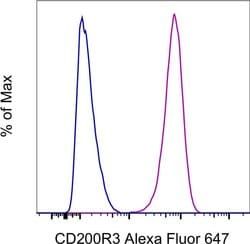
- Applications Tested: This OX110 antibody has been tested by flow cytometric analysis of mouse thioglycolate-elicited peritoneal cells
- This can be used at less than or equal to 0.25 μg per test
- A test is defined as the amount (μg) of antibody that will stain a cell sample in a final volume of 100 μL
- Cell number should be determined empirically but can range from 10^5 to 10^8 cells/test
- It is recommended that the antibody be carefully titrated for optimal performance in the assay of interest
- PerCP-eFluor™ 710 can be used in place of PE-Cy5, PE-Cy5.5 or PerCP-Cy5.5
- CD200R (OX2R) is a receptor for the OX-2 membrane glycoprotein, and both the receptor and substrate are cell surface glycoproteins containing two immunoglobulin-like domains
- CD200R is restricted to the surfaces of myeloid lineage cells and the receptor-substrate interaction may function as a myeloid downregulatory signal
- In mouse, CD200R is expressed primarily by peripheral blood monocytes and neutophils but also by other leucocytes including T-lymphocytes and mast cells
- Further mouse studies of a gene related to CD200R suggests that the receptor may control myeloid function in a tissue-specific manner
- Alternative splicing of CD200R results in multiple transcript variants
- Diseases associated with CD200R dysfunction include primary hypertrophic osteoarthropathy.