50-271-8486
G-CSF Polyclonal Antibody, Biotin, PeproTech®, Invitrogen™
Manufacturer: Fischer Scientific
Select a Size
| Pack Size | SKU | Availability | Price |
|---|---|---|---|
| Each of 1 | 50-271-8486-Each-of-1 | In Stock | ₹ 1,75,552.50 |
50-271-8486 - Each of 1
In Stock
Quantity
1
Base Price: ₹ 1,75,552.50
GST (18%): ₹ 31,599.45
Total Price: ₹ 2,07,151.95
Antigen
G-CSF
Classification
Polyclonal
Conjugate
Biotin
Gene
Csf3
Gene Alias
C17orf33; colony stimulating factor 3; colony stimulating factor 3 (granulocyte); CSF 3; CSF3; CSF3OS; Csfg; filgrastim; GCSF; G-CSF; Granulocyte colony-stimulating factor; granulocyte-colony stimulating factor; gsf3; lenograstim; MGC45931; MGI-IG; Pluripoietin; RP23-395E10.4
Host Species
Rabbit
Purification Method
Antigen affinity chromatography
Regulatory Status
RUO
Gene ID (Entrez)
1440
Content And Storage
-20°C
Isotype
IgG
Applications
Western Blot, ELISA
Concentration
0.1-1.0 mg/mL
Formulation
PBS with no preservative
Gene Accession No.
P09919
Gene Symbols
Csf3
Immunogen
E.coli-derived Recombinant Human G-CSF
Quantity
500μg
Primary or Secondary
Primary
Target Species
Human
Form
Lyophilized
Related Products


Description
- AA Sequence of recombinant protein: TPLGPASSLP QSFLLKCLEQ VRKIQGDGAA LQEKLCATYK LCHPEELVLL GHSLGIPWAP LSSCPSQALQ LAGCLSQLHS GLFLYQGLLQ ALEGISPELG PTLDTLQLDV ADFATTIWQQ MEELGMAPAL QPTQGAMPAF ASAFQRRAGG VLVASHLQSF LEVSYRVLRH LAQP
- Preparation: Produced from sera of rabbits immunized with highly pure Recombinant Human G-CSF
- Anti-Human G-CSF-specific antibody was purified by affinity chromatography and then biotinylated
- Sandwich ELISA: To detect hG-CSF by sandwich ELISA (using 100 μL/well antibody solution) a concentration of 0.25-1.0 μg/mL of this antibody is required
- This biotinylated polyclonal antibody, in conjunction with PeproTech Polyclonal Anti-Human G-CSF (500-P43) as a capture antibody, allows the detection of at least 0.2-0.4 ng/well of Recombinant hG-CSF
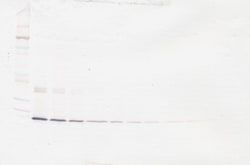
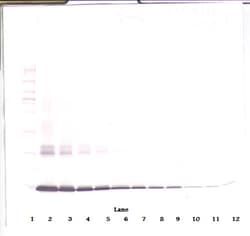
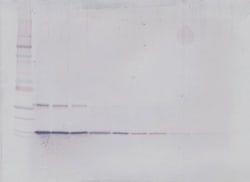
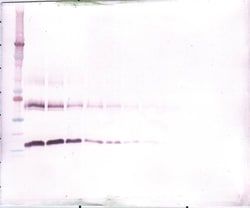
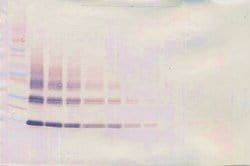
- Western Blot: To detect hG-CSF by Western Blot analysis this antibody can be used at a concentration of 0.1-0.2 μg/mL
- Used in conjunction with compatible secondary reagents the detection limit for Recombinant hG-CSF is 1.5-3.0 ng/lane, under either reducing or non-reducing conditions
- 500-P43BT-1MG will be provided as 2 x 500 μg G-CSF (Granulocyte colony stimulating factor) is a naturally occurring cytokine that stimulates the production and antibacterial function of neutrophils and monocytes
- Human G-CSF is an 18.8 kDa protein containing 175 amino acid residues, and a soluble isoform of the G-CSF receptor has been described
- The pleotropic cytokine is produced by activated monocytes, macrophages, endothelial cells, fibroblasts, astrocytes, osteoblasts and bone marrow cells
- G-CSF has been shown to have specific effects on the proliferation, differentiation and activation of hematopoietic cells
- G-CSF is also expressed by various transformed cells such as carcinoma cells and myeloblastic leukemia cells
- G-CSF is encoded by two distinct DNA sequences, resulting in a full size, high activity and a shorter, low activity isoform of G-CSF
- G-CSF is highly conserved among species and has been shown to exert its biological functions through interaction with its receptor expressed on the surface of hematopoietic progenitors, neutrophilic granulocytes and certain carcinoma cell lines
- Clinical use of G-CSF has been approved for several therapeutic applications, treatment of neonatal infections, therapy of acute myocardial infarction, granulocyte transfusion in patients with neutropenia, in severe infections and sepsis, therapy in chronic autoimmune neutropenia, treatment of acute myeloid leukemias, Sweet's syndrome and AIDS
- Further, G-CSF has been shown to be a marker protein for different carcinomas such as bladder cancer and dysfunction of the protein has been linked to Kostmann Syndrome.