FAS (soluble) Polyclonal Antibody, Biotin, PeproTech®, Invitrogen™
Manufacturer: Fischer Scientific
Select a Size
| Pack Size | SKU | Availability | Price |
|---|---|---|---|
| Each of 1 | 50-271-8533-Each-of-1 | In Stock | ₹ 1,75,552.50 |
50-271-8533 - Each of 1
In Stock
Quantity
1
Base Price: ₹ 1,75,552.50
GST (18%): ₹ 31,599.45
Total Price: ₹ 2,07,151.95
Antigen
FAS (soluble)
Classification
Polyclonal
Conjugate
Biotin
Gene
FAS
Gene Alias
AI196731; ALPS1A; APO1; APO-1; Apo1 antigen; Apo-1 antigen; APO-1 cell surface antigen; Apo-1 Fas; apoptosis antigen 1; apoptosis signaling receptor FAS; apoptosis-mediating surface antigen FAS; APT1; CD95; CD95 antigen; FAS; Fas (TNF receptor superfamily member 6); Fas (TNF receptor superfamily member); Fas (TNF receptor superfamily, member 6); Fas AMA; Fas antigen; Fas antigen (ATP1); Fas cell surface death receptor; Fas receptor; FAS1; FASLG receptor; FASTM; lpr; lymphoproliferation; OTTHUMP00000020045; OTTHUMP00000020046; OTTHUMP00000020051; OTTHUMP00000059646; TNF receptor superfamily member 6; TNFR6; Tnfrsf6; tumor necrosis factor receptor superfamily member 6; tumor necrosis factor receptor superfamily member 6; tumor necrosis factor receptor superfamily member 26; Tumor necrosis factor receptor superfamily, member 6
Host Species
Rabbit
Purification Method
Antigen affinity chromatography
Regulatory Status
RUO
Gene ID (Entrez)
355
Content And Storage
-20°C
Isotype
IgG
Applications
Western Blot, ELISA
Concentration
0.1-1.0 mg/mL
Formulation
PBS with no preservative
Gene Accession No.
P25445
Gene Symbols
FAS
Immunogen
E.coli-derived Recombinant Human sFas Receptor
Quantity
500μg
Primary or Secondary
Primary
Target Species
Human
Form
Lyophilized
Related Products


Description
- AA Sequence of recombinant protein: MRLSSKSVNA QVTDINSKGL ELRKTVTTVE TQNLEGLHHD GQFCHKPCPP GERKARDCTV NGDEPDCVPC QEGKEYTDKA HFSSKCRRCR LCDEGHGLEV EINCTRTQNT KCRCKPNFFC NSTVCEHCDP CTKCEHGIIK ECTLTSNTKC KEEGSRS
- Preparation: Produced from sera of rabbits immunized with highly pure Recombinant Human sFas Receptor
- Anti-Human sFas Receptor-specific antibody was purified by affinity chromatography and then biotinylated
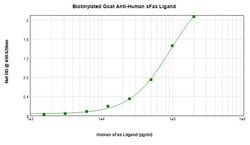
- Sandwich ELISA: To detect Human sFas Receptor by sandwich ELISA (using 100 mL/well) a concentration of 0.25-1.0 μg/mL of this antibody is required
- This biotinylated polyclonal antibody, in conjunction with PeproTech Polyclonal Anti- Human sFas Receptor (500-P295) as a capture antibody, allows the detection of at least 0.2-0.4 ng/well of Recombinant Human sFas Receptor
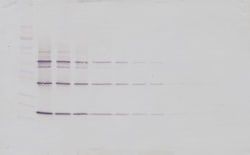
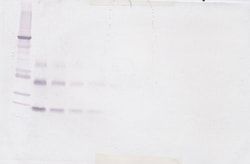
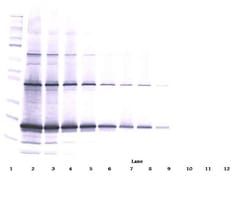
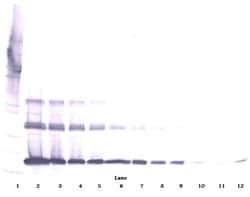
- Western Blot: To detect Human sFas Receptor by Western Blot analysis this antibody can be used at a concentration of 0.1-0.2 mg/mL
- When used in conjunction with compatible development reagents the detection limit for Recombinant Human sFas Receptor is 1.5-3.0 ng/lane, under either reducing or non-reducing conditions
- 500-P295BT-1MG will be provided as 2 x 500 μg FAS (Fas, CD95, APO-1) is a 46 kDa transmembrane glycoprotein that functions as a cell death receptor of the TNFR (tumor necrosis factor receptor) superfamily
- FAS also exists in a soluble form that weight approximately 26kDa
- Stimulation of FAS results in aggregation of its intracellular FAS-associated death domains (FADD), formation of the death-inducing signaling complex (DISC) and activation of caspases
- The auto-proteolytic processing of the caspases in the complex trigger a downstream cascade that leads to apoptosis
- FAS has been shown to activate NF-kappaB, MAPK3/ERK1, MAPK8/JNK, and is involved in transducing the proliferating signals in normal diploid fibroblast and T cells
- At least eight alternatively spliced transcript variants encoding seven distinct isoforms have been described
- The isoforms lacking the transmembrane domain may negatively regulate the apoptosis mediated by the full-length isoform
- The Fas/Fas ligand system has been shown to play a role in a number of human diseases such as AIDS, hepatitis and cancer
- It is also assumed that induction of apoptosis through FAS ligand pathway is predominantly involved in anti-viral immune responses.