50-884-382
SSEA4 Monoclonal Antibody (eBioMC-813-70 (MC-813-70)), eFluor™ 660, eBioscience™, Invitrogen™
Manufacturer: Fischer Scientific
Select a Size
| Pack Size | SKU | Availability | Price |
|---|---|---|---|
| Each of 1 | 50-884-382-Each-of-1 | In Stock | ₹ 40,050.00 |
50-884-382 - Each of 1
In Stock
Quantity
1
Base Price: ₹ 40,050.00
GST (18%): ₹ 7,209.00
Total Price: ₹ 47,259.00
Antigen
SSEA4
Classification
Monoclonal
Concentration
0.2 mg/mL
Formulation
PBS with 0.09% sodium azide; pH 7.2
Host Species
Mouse
Quantity
100 μg
Primary or Secondary
Primary
Content And Storage
4° C, store in dark, DO NOT FREEZE!
Form
Liquid
Applications
Flow Cytometry, Immunocytochemistry
Clone
eBioMC-813-70 (MC-813-70)
Conjugate
eFluor 660
Gene Alias
SSEA-4; stage-specific embryonic antigen 4
Purification Method
Affinity chromatography
Regulatory Status
RUO
Target Species
Canine, Chicken, Human, Mouse, Non-human Primate, Rabbit
Product Type
Antibody
Isotype
IgG3
Related Products
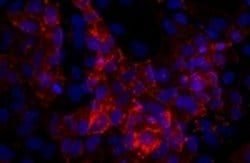



Description
- The eBioMC-813-70 MAb reacts with a glycolipid carbohydrate epitope on Stage-specific embryonic antigen-4 (SSEA-4) protein
- Expression is found on human teratocarcinoma stem cells (EC), human embryonic germ cells (EG), human induced pluripotent stem (iPS) cells, and human embryonic stem cells (ES) with a decrease in expression upon differentiation
- Recently expression has also been found on bone marrow mesenchymal stem cells
- The eBioMC-813-70 antibody has been reported to crossreact to mouse, rabbit, canine, chicken, and Old and New World monkeys
- SSEA-4 (Stage-specific embryonic antigen 4) is a cell surface antigen, expressed along with SSEA-3, TRA-1-60 and TRA-1-81 in embryonic stem cells, embryonal carcinoma cells and induced pluripotent stem cells (iPS)
- In human cells, these surface markers are down-regulated during the differentiation process, while SSEA-1 is absent in undifferentiated human stem cells and upregulated on the cell surface after retinoic acid mediated differentiation
- Conversely, in mouse stem cells, SSEA-1 expression decreases with differentiation while SSEA-3 and SSEA-4 expression increase.