CD71 (Transferrin Receptor) Monoclonal Antibody (OKT9 (OKT-9)), Super Bright™ 600, eBioscience™, Invitrogen™
Manufacturer: Invitrogen
Select a Size
| Pack Size | SKU | Availability | Price |
|---|---|---|---|
| Each | 63-071-942-Each | In Stock | ₹ 27,024.85 |
63-071-942 - Each
In Stock
Quantity
1
Base Price: ₹ 27,024.85
GST (18%): ₹ 4,864.473
Total Price: ₹ 31,889.323
Antigen
CD71 (Transferrin Receptor)
Classification
Monoclonal
Concentration
5 μL/Test
Formulation
PBS with BSA and 0.09% sodium azide; pH 7.2
Gene Accession No.
P02786
Gene Symbols
TFRC
Purification Method
Affinity chromatography
Regulatory Status
RUO
Gene ID (Entrez)
7037
Content And Storage
4° C, store in dark, DO NOT FREEZE!
Form
Liquid
Applications
Flow Cytometry
Clone
OKT9 (OKT-9)
Conjugate
Super Bright 600
Gene
TFRC
Gene Alias
2610028K12Rik; AI195355; AI426448; AU015758; CD antigen CD71; CD71; chicken transferrin receptor; E430033M20Rik; I79_000642; IMD46; mammary tumor virus receptor 1; Mtvr1; Mtvr-1; p90; sTfR; T9; TfR; tfR1; TFR2; TFRC; TR; transferrin receptor; transferrin receptor (p90, CD71); transferrin receptor 2; transferrin receptor protein 1; Transferrin receptor protein 1, serum form; Trfr
Host Species
Mouse
Quantity
100 Tests
Primary or Secondary
Primary
Target Species
Human
Product Type
Antibody
Isotype
IgG1 κ
Related Products


Description
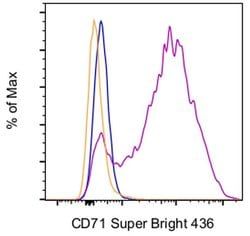
- The OKT9 MAb reacts with human CD71, a 170-180 kDa type II transmembrane protein
- CD71, the transferrin receptor, exists as a homodimer on the cell surface and is essential for cellular growth
- CD71 is expressed by immature proliferating cells and at low levels on resting mature lymphocytes
- Antigen or mitogen stimulation of T and B cells upregulates the expression of CD71
- Cellular uptake of iron occurs via receptor-mediated endocytosis of ligand-occupied transferrin receptor into specialized endosomes
- Endosomal acidification leads to iron release
- The apotransferrin-receptor complex is then recycled to the cell surface with a return to neutral pH and the concomitant loss of affinity of apotransferrin for its receptor
- Transferrin receptor is necessary for development of erythrocytes and the nervous system
- Serum transferrin receptor (sTfR) is used as a means of detecting erythropoietin (EPO) misuse by athletes and as a diagnostic test for anemias resulting from a number of conditions including rheumatoid arthritis, pregnancy, irritable bowel syndrome and in HIV patients.