CD366 (TIM3) Monoclonal Antibody (8B.2C12), Super Bright™ 645, eBioscience™, Invitrogen™
Manufacturer: Invitrogen
Select a Size
| Pack Size | SKU | Availability | Price |
|---|---|---|---|
| Each of 1 | 64-587-182-Each-of-1 | In Stock | ₹ 33,108.00 |
64-587-182 - Each of 1
In Stock
Quantity
1
Base Price: ₹ 33,108.00
GST (18%): ₹ 5,959.44
Total Price: ₹ 39,067.44
Antigen
CD366 (TIM3)
Classification
Monoclonal
Concentration
0.2 mg/mL
Formulation
PBS with BSA and 0.09% sodium azide; pH 7.2
Gene Accession No.
Q8VIM0
Gene Symbols
Havcr2
Purification Method
Affinity chromatography
Regulatory Status
RUO
Gene ID (Entrez)
171285
Content And Storage
4° C, store in dark, DO NOT FREEZE!
Form
Liquid
Applications
Flow Cytometry
Clone
8B.2C12
Conjugate
Super Bright 645
Gene
Havcr2
Gene Alias
CD366; FLJ14428; Havcr2; HAVcr-2; Hepatitis A virus cellular receptor 2; hepatitis A virus cellular receptor 2 homolog; kidney injury molecule-3; KIM-3; sCD366; soluble CD366; soluble TIM 3; T cell immunoglobulin mucin 3; T cell immunoglobulin mucin-3; T-cell immunoglobulin and mucin domain containing 3; T-cell immunoglobulin and mucin domain-containing protein 3; T-cell immunoglobulin mucin family member 3; T-cell immunoglobulin mucin receptor 3; T-cell membrane protein 3; Tim3; TIM-3; TIMD3; TIMD-3
Host Species
Rat
Quantity
100μg
Primary or Secondary
Primary
Target Species
Mouse
Product Type
Antibody
Isotype
IgG1 κ
Related Products


Description
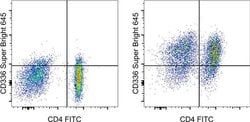
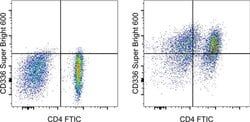
- Description: The 8B.2C12 monoclonal antibody reacts with mouse CD366 (TIM3), a Th1-specific cell surface protein
- CD366 is a type I transmembrane protein and contains an immunoglobulin and a mucin-like domain in its extracellular portion and a tyrosine phosphorylation motif in its cytoplasmic portion
- CD366 is expressed selectively by differentiated CD4+ Th1 and CD8+ Tc1, but is absent on Th2 and Tc2
- Other hematopoietic cell types, including naive T cells, B cells, macrophages and dendritic cells, do not express CD366, at least at the protein level
- Expression of CD366 is upregulated at a late stage of T cell differentiation on Th1 cells after 3 rounds of in vitro polarization suggesting a role for this molecule in the transport or effector function of Th1 cells rather than a contribution to T cell differentiation
- In an experimental autoimmune encephalomyelitis (EAE) model, CD366 was shown to be expressed on most CD4+ and CD8+ T cells in the central nervous system at the onset of clinical signs of disease, while less than 2% of CD4+ cells in the periphery expressed CD366 after immunization
- In this model, in vivo administration of 8B.2C12 resulted in a hyperacute and atypical disease phenotype
- It is postulated that the engagement of CD366 during T cell activation results in the expansion and activation of macrophages and increased severity of autoimmune disease
- The Tim gene family may have an important role in the regulation of autoimmunity and allergies
- TIM3 (Hepatitis A virus cellular receptor 2, HAVCR2, T-cell immunoglobulin, mucin-dmain containing-3) is a 281 amino acid long, Type-1 Th1- specific cell surface glycoprotein expressed on terminally differentiated CD4+Th1 and CD8+Tc1 cells
- TIM3 consists of an IgV-like domain, a mucin-like domain in the extracellular region, and a conserved Tyrosine phosphorylation motif in the cytoplasmic region
- TIM3 is involved in macrophage activation and induction of autoimmune diseases
- Further, TIM3 down-regulates aggressive Th1-mediated immune responses and facilitates in the development of immune tolerance
- Pathological significance of TIM3 has been attributed to Experimental autoimmune encephalomyelitis (EAE), a Th-1 dependent autoimmune disease, and also enhances the severity of experimental autoimmune encephalomyelitis in mice.