Glutamine Synthetase Recombinant Rabbit Monoclonal Antibody (7H9L16), Invitrogen™
Manufacturer: Thermo Scientific
Select a Size
| Pack Size | SKU | Availability | Price |
|---|---|---|---|
| Each of 1 | 70-198-9-Each-of-1 | In Stock | ₹ 48,994.50 |
70-198-9 - Each of 1
In Stock
Quantity
1
Base Price: ₹ 48,994.50
GST (18%): ₹ 8,819.01
Total Price: ₹ 57,813.51
Antigen
Glutamine Synthetase
Classification
Recombinant Monoclonal
Concentration
0.5 mg/mL
Formulation
PBS with 0.09% sodium azide; pH 7.2
Gene Accession No.
P09606, P15104, P15105
Gene Symbols
GLUL
Immunogen
Protein corresponding to Human GLUL (aa 2-373)
Quantity
100 μg
Primary or Secondary
Primary
Target Species
Human, Mouse, Rat
Product Type
Antibody
Isotype
IgG
Applications
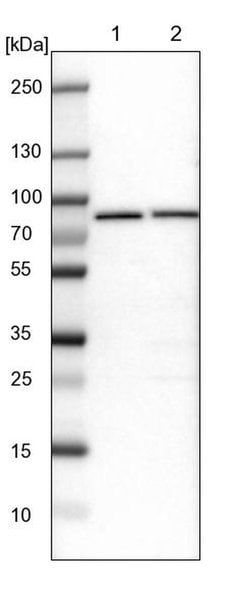
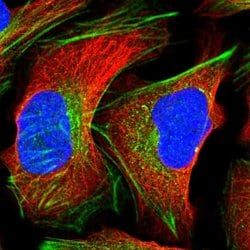
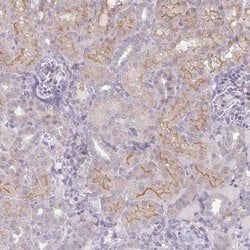
Immunocytochemistry, Immunohistochemistry (Frozen), Western Blot
Clone
7H9L16
Conjugate
Unconjugated
Gene
GLUL
Gene Alias
cell proliferation-inducing protein 59; GLNA; GLNS; Glul; GLUL protein; Glutamate ammonia ligase; glutamate decarboxylase; glutamate-ammonia ligase; glutamate--ammonia ligase; glutamate-ammonia ligase (glutamine synthase); glutamate-ammonia ligase (glutamine synthetase); glutamine synthase; glutamine synthetase; Glutamine synthetase (glutamate-ammonia ligase); glutamine synthetase 1; glutamine synthetase I; GS; Palmitoyltransferase GLUL; PIG43; PIG59; Proliferation inducing protein 43; proliferation-inducing protein 43
Host Species
Rabbit
Purification Method
Protein A
Regulatory Status
RUO
Gene ID (Entrez)
14645, 24957, 2752
Content And Storage
Store at 4°C short term. For long term storage, store at -20°C, avoiding freeze/thaw cycles.
Form
Liquid
Related Products



Description
- This antibody is predicted to react with Monkey, Cat and Pig
- Recombinant rabbit monoclonal antibodies are produced using in vitro expression systems
- The expression systems are developed by cloning in the specific antibody DNA sequences from immunoreactive rabbits
- Then, individual clones are screened to select the best candidates for production
- The advantages of using recombinant rabbit monoclonal antibodies include: better specificity and sensitivity, lot-to-lot consistency, animal origin-free formulations, and broader immunoreactivity to diverse targets due to larger rabbit immune repertoire
- Glutamine synthase is part of the glutamine synthetase family
- Ammonia incorporation in animals occurs through the actions of glutamate dehydrogenase and glutamine synthase
- Glutamate plays the central role in mammalian nitrogen flow, serving as both a nitrogen donor and nitrogen acceptor
- It also has an important role in controlling metabolic regulations of neurotransmitter glutamate
- Because of the multiple functions and importance of GS in cellular metabolism, both catalytic activities and synthesis are highly regulated
- The activity of GS is controlled by adenylylation
- Its activity is decreased in the cerebral cortex of brains affected by Alzheimer's disease, particularly in the vicinity of senile plaques
- It is also decreased under conditions of glucose deprivation.