7068114
CD201 (EPCR) Monoclonal Antibody (eBio1560 (1560)), PE, eBioscience™, Invitrogen™
Rat Monoclonal Antibody
Manufacturer: Fischer Scientific
The price for this product is unavailable. Please request a quote
Antigen
CD201 (EPCR)
Concentration
0.2 mg/mL
Classification
Monoclonal
Form
Liquid
Regulatory Status
RUO
Formulation
PBS with 0.09% sodium azide; pH 7.2
Gene Alias
Activated protein C receptor; AI325044; APC receptor; bA42O4.2; CCCA; CCD41; CD antigen CD201; CD201; CD201 antigen; cell cycle, centrosome-associated protein; centrocyclin; Centrosomal protein CCD41; endothelial cell protein C receptor; Endothelial protein C receptor; Epcr; PROCR; protein C receptor; protein C receptor, endothelial
Gene Symbols
Procr
Primary or Secondary
Primary
Content And Storage
4° C, store in dark, DO NOT FREEZE!
Gene
Procr
Clone
eBio1560 (1560)
Applications
Flow Cytometry
Conjugate
PE
Host Species
Rat
Target Species
Mouse
Gene Accession No.
Q64695
Gene ID (Entrez)
19124
Isotype
IgG2b κ
Purification Method
Affinity chromatography
Product Type
Antibody
Related Products


Description
- Description: The eBio1560 monoclonal antibody reacts with mouse Endothelial Protein C Receptor (EPCR, CD201), a 25 kDa Type 1 transmembrane protein expressed on endothelial cells
- EPCR exhibits sequence and structural homology with the MHC class I/CD1 family of proteins
- EPCR is a ligand for Protein C and plays an important role in augmenting Protein C activation by the thrombin-thrombomodulin complex and in regulating blood coagulation and inflammation
- Deletion of EPCR results in embryonic lethality, at least partically due to placental thrombosis
- Recently, it was demonstrated that EPCR expression identified cells in the bone marrow that are capable of hematopoietic reconstitution activity comparable to hematopoietic stem cells isolated with conventional methods
- The eBio1560 monoclonal antibody can be used for the detection of these hematopoietic stem cells, however the eBiomRCR-16 monoclonal antibody should only be used for the detection of CD201 on endothelial cells
- Applications Reported: This eBio1560 (1560) antibody has been reported for use in flow cytometric analysis
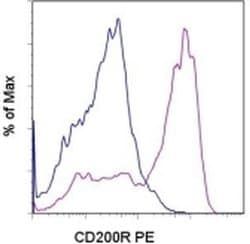
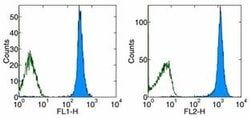
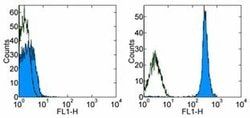
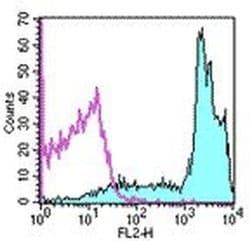
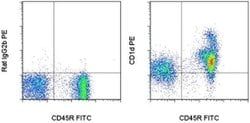
- Applications Tested: This eBio1560 (1560) antibody has been tested by flow cytometric analysis of the bEnd.3 cell line
- This can be used at less than or equal to 1 μg per test
- A test is defined as the amount (μg) of antibody that will stain a cell sample in a final volume of 100 μL
- The protein encoded by this gene is a receptor for activated protein C, a serine protease activated by and involved in the blood coagulation pathway
- The encoded protein is an N-glycosylated type I membrane protein that enhances the activation of protein C
- Mutations in this gene have been associated with venous thromboembolism and myocardial infarction, as well as with late fetal loss during pregnancy.