7068287
AHR Monoclonal Antibody (4MEJJ), PE, eBioscience™, Invitrogen™
Rat Monoclonal Antibody
Manufacturer: Fischer Scientific
The price for this product is unavailable. Please request a quote
Antigen
AHR
Concentration
0.2 mg/mL
Classification
Monoclonal
Form
Liquid
Regulatory Status
RUO
Formulation
PBS with 0.09% sodium azide; pH 7.2
Gene Alias
Ah; Ah receptor; Ahh; Ahr; Ahre; AH-receptor; aromatic hydrocarbon receptor; aryl hydrocarbon receptor; aryl-hydrocarbon receptor; bHLHe76; Class E basic helix-loop-helix protein 76; dioxin receptor; In
Gene Symbols
AHR
Isotype
IgG2a κ
Purification Method
Affinity chromatography
Product Type
Antibody
Clone
4MEJJ
Applications
Flow Cytometry
Conjugate
PE
Host Species
Rat
Target Species
Mouse
Gene Accession No.
P30561
Gene ID (Entrez)
11622
Immunogen
E. coli derived, His-tagged AHR (aa 443-805)
Primary or Secondary
Primary
Content And Storage
4° C, store in dark, DO NOT FREEZE!
Gene
AHR
Related Products


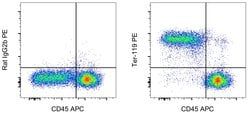
Description
- Description: This 4MEJJ monoclonal antibody recognizes mouse aryl hydrocarbon receptor (AHR)
- The AHR is a ligand-activated transcription factor that mediates the toxic effects of a diverse group of environmental contamits, most notably aryl hydrocarbons such as polychlorinated biphenyls (PCB) and tetrachlorodibenzo-p-dioxin (TCDD)
- The AHR has also been shown to bind to a number of naturally occurring compounds found in fruits and vegetables as well as compounds generated through normal cellular metabolism
- AHR is localized in the cytoplasm in a complex that includes HSP90, p23, and XAP2/AIP/ARA9
- Upon ligand-binding, AHR translocates to the nucleus and binds with aryl hydrocarbon receptor nuclear translocator (ARNT), and this complex binds to the consensus DNA sequence, GCGTG, found in the promoter/enhancer regions of many genes such as CYP1A1
- The AHR is expressed in many cell types, with highest expression levels found in liver
- The AHR has been shown to play a role in the regulation/differentiation of Treg and Th17 cells
- The 4MEJJ monoclonal antibody has been found to recognize the b-1, b-2 and d alleles of mouse AHR but does not crossreact with human AHR
- Applications Reported: This 4MEJJ antibody has been reported for use in intracellular staining followed by flow cytometric analysis
- AHR (Ah Receptor) belongs to a family of proteins comprised of its dimerization partner ARNT (HIF-1 Beta) and the Drosophila proteins PER and SIM
- AHR contains an N-terminal sequence of approximately 200 amino acids termed the PAS domain
- AHR, found in a variety of tissues, binds to a specific DNA enhancer sequence and initiates transcription of the mRNA for the cytochrome P-450 (CYPIA1) gene
- The gene for AHR encodes a ligand-activated transcription factor involved in the regulation of biological responses to planar aromatic hydrocarbons
- AHR has been shown to regulate xenobiotic-metabolizing enzymes such as cytochrome P450, and its ligands included a variety of aromatic hydrocarbons
- AHR is a ligand-activated helix/loop/helix transcription factor found in a variety of vertebrate species
- The known ligands for AHR are foreign planar aromatic compounds, such as polycyclic aromatic compounds and halogenated aromatic compounds such as 2,3,7,8-tetrachlorodibenzo-p-dioxin (TCDD)
- Unlike the steroid/thyroid hormone receptors, there is no known physiological ligand for AHR
- Studies indicate that in non-ligand activated cells, AHR is found complexed with HSP90 predominantly in the cytoplasm
- Upon binding to an agonist, the ligand-activated AhR is believed to transform to a nuclear, DNA binding form, and this transformation process appears to involve dissociation of HSP90 from AhR followed by formation of a heterodimer with AhR nuclear translocator protein (Arnt)
- Diseases associated with AHR include eosinophilic fasciitis and seborrheic dermatitis.