7068124
CD223 (LAG-3) Monoclonal Antibody (eBioC9B7W (C9B7W)), PE, eBioscience™, Invitrogen™
Rat Monoclonal Antibody
Manufacturer: Fischer Scientific
The price for this product is unavailable. Please request a quote
Antigen
CD223 (LAG-3)
Concentration
0.2 mg/mL
Classification
Monoclonal
Form
Liquid
Regulatory Status
RUO
Formulation
PBS with 0.09% sodium azide; pH 7.2
Gene Alias
Activation-induced cytidine deaminase-linked autoimmunity protein; Aida; CD223; FDC; LAG3; LAG-3; Ly66; lymphocyte activating 3; lymphocyte activation gene 3 protein; lymphocyte-activation gene 3; Secreted lymphocyte activation gene 3 protein; sLAG 3; sLAG3; sLAG-3; soluble LAG 3lymphocyte activating 3; soluble LAG3
Gene Symbols
LAG3
Primary or Secondary
Primary
Content And Storage
4° C, store in dark, DO NOT FREEZE!
Gene
LAG3
Clone
eBioC9B7W (C9B7W)
Applications
Flow Cytometry
Conjugate
PE
Host Species
Rat
Target Species
Mouse
Gene Accession No.
Q61790
Gene ID (Entrez)
16768
Isotype
IgG1 κ
Purification Method
Affinity chromatography
Product Type
Antibody
Related Products


Description
- Description: The eBioC9B7W monoclonal antibody recognizes mouse CD223 (LAG-3, LAG3) protein expressed by activated alpha/beta-TCR bearing T cells, a subset of gamma/delta-TCR bearing T cells and a subset of NK cells
- CD223 is a 70 kDa type I transmembrane protein with a structure that is similar to CD4
- However, a soluble form of human CD223 has been detected by ELISA in human serum, and data suggest that mouse CD223 is proteolytically cleaved in the D4 domain
- This results in a 54 kDa fragment containing all the extracellular domains, and a 16 kDa fragment containing the intracellular and transmembrane domains
- The 54 kDa can remain membrane-associated or be released as soluble CD223
- CD223 binds to MHC class II with higher affinity than CD4, and it is thought that this interaction is involved in the negative regulation of T-cell activation and homeostatic proliferation
- Furthermore, CD223 is expressed by CD4+CD25+ regulatory T cells, and it has been suggested that CD223 may be involved in their regulatory function
- Applications Reported: This eBioC9B7W (C9B7W) antibody has been reported for use in flow cytometric analysis
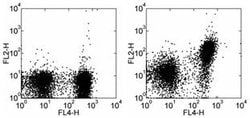
- Applications Tested: This eBioC9B7W (C9B7W) antibody has been tested by flow cytometric analysis of stimulated mouse splenocytes
- This can be used at less than or equal to 0.5 μg per test
- A test is defined as the amount (μg) of antibody that will stain a cell sample in a final volume of 100 μL
- LAG-3 is a 70-kDa surface glycoprotein belonging to the Ig superfamily with homology to CD4
- LAG-3 binds to MHC class II with higher affinity than CD4 and is thought to be involved in the negative regulation of T cell activation and homeostatic proliferation
- Surface expression of LAG-3 has been reported on activated T cells (including regulatory T cells) and NK cells
- CD8+ T cells usually express LAG-3 at significantly higher levels than CD4+ T cells
- Coexpression of LAG-3 and CD49b has been proposed to identify human and mouse Type 1 regulatory T cells (Tr1 cells).