7068921
CD150 Monoclonal Antibody (9D1), PE, eBioscience™, Invitrogen™
Rat Monoclonal Antibody
Manufacturer: Fischer Scientific
The price for this product is unavailable. Please request a quote
Antigen
CD150
Concentration
0.2 mg/mL
Classification
Monoclonal
Form
Liquid
Regulatory Status
RUO
Formulation
PBS with 0.09% sodium azide; pH 7.2
Gene Alias
4933415F16; AA177906; CD150; CD150 antigen; CDw150; ESTM51; IPO-3; RGD1560634; signaling lymphocyte activation molecule; signaling lymphocytic activation molecule; signaling lymphocytic activation molecule family member 1; Slam; SLAM family member 1; Slamf1
Gene Symbols
Slamf1
Primary or Secondary
Primary
Content And Storage
4° C, store in dark, DO NOT FREEZE!
Gene
Slamf1
Clone
9D1
Applications
Flow Cytometry
Conjugate
PE
Host Species
Rat
Target Species
Mouse
Gene Accession No.
Q9QUM4
Gene ID (Entrez)
27218
Isotype
IgG1 κ
Purification Method
Affinity chromatography
Product Type
Antibody
Related Products

Description
- Description: The 9D1 monoclonal antibody reacts with mouse CD150, an ∽70 kDa transmembrane glycoprotein also known as Signaling Lymphocyte Activation Molecule (SLAM)
- CD150 is expressed by T (especially TH1) and B cells and its expression is rapidly upregulated on these cells upon activation
- Immature thymocytes and dendritic cells also express this antigen
- Signaling through SLAM in T cells induces proliferation and augmentation of the interferon-gamma response
- Furthermore, SLAM is thought to play a role in adhesion between the T cell and antigen-presenting cell
- 9D1 is reported to be an activating antibody
- Mouse hematopoietic stem cells (HSC) can be identified using SLAM family markers, such as CD150+CD244-CD48-
- For this application we recommend the use of antibody clone mShad150 (cat
- 12-1502)
- Applications Reported: This 9D1 antibody has been reported for use in flow cytometric analysis
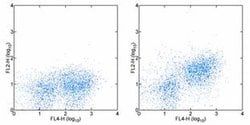
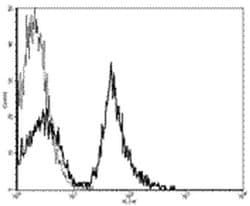
- Applications Tested: This 9D1 antibody has been tested by flow cytometric analysis of mouse thymic and splenic cells
- This can be used at less than or equal to 0.5 μg per test
- A test is defined as the amount (μg) of antibody that will stain a cell sample in a final volume of 100 μL
- Cell number should be determined empirically but can range from 10^5 to 10^8 cells/test
- It is recommended that the antibody be carefully titrated for optimal performance in the assay of interest
- CD150 (SLAM, Signaling Lymphocyte Activation Molecule) belongs to the immunoglobulin gene superfamily, and is involved in T cell stimulation
- SLAM is constitutively expressed on peripheral blood memory T cells, T cell clones, immature thymocytes, and a proportion of B cells, and is rapidly induced on naive T cells after activation
- Activated B cells express the membrane bound form, the soluble form and the cytoplasmic isoforms of SLAM
- It is suggested that signalling through homophilic SLAM-SLAM binding during B to B and B to T cell interactions enhances the expansion and differentiation of activated B cells
- Reports suggest that the extracellular domain of CD150 is the receptor for the measles virus and acts as a co-activator on T cells and B cells
- Moreover, CD150 is thought to interact with SH2D1A and with PTPN11 via its cytoplasmic domain
- Mutations CD150 gene may be associated with X-linked lympho-proliferative disease (XLP).