7068237
IRF7 Monoclonal Antibody (MNGPKL), PE, eBioscience™, Invitrogen™
Rat Monoclonal Antibody
Manufacturer: Fischer Scientific
The price for this product is unavailable. Please request a quote
Antigen
IRF7
Concentration
0.2 mg/mL
Classification
Monoclonal
Form
Liquid
Regulatory Status
RUO
Formulation
PBS with 0.09% sodium azide; pH 7.2
Gene Alias
IMD39; Interferon regulatory factor 7; interferon regulatory factor-7H; Irf7; IRF-7; IRF7A; IRF7B; IRF7C; IRF7H; IRF-7H
Gene Symbols
IRF7
Primary or Secondary
Primary
Content And Storage
4° C, store in dark, DO NOT FREEZE!
Gene
IRF7
Clone
MNGPKL
Applications
Flow Cytometry
Conjugate
PE
Host Species
Rat
Target Species
Mouse
Gene Accession No.
P70434
Gene ID (Entrez)
54123
Isotype
IgG2a κ
Purification Method
Affinity chromatography
Product Type
Antibody
Related Products


Description
- Description: The monoclonal antibody MNGPKL reacts with mouse interferon regulatory factor 7 (IRF7), a 54 kDa transcription factor essential for induction of the antiviral innate immune response and IFN alpha production
- B cells, plasmacytoid dendritic cells (pDC), and monocytes constitutively express IRF7 in the cytoplasm until activation by viral infection, double-stranded RNA or Toll-like receptor (TLR) signaling
- CpG ODNs and single-stranded RNA, recognized by CD289 (TLR9) and TLR7, respectively, trigger IRF7 activation and upregulation
- This activation promotes type I IFN response to disrupt pathogen and viral infection
- These events cause IRF7 phosphorylation and translocation to the nucleus where it forms a homodimer to affect transcription
- Applications Reported: This MNGPKL antibody has been reported for use in intracellular staining followed by flow cytometric analysis
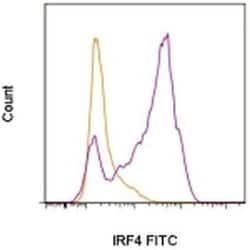
- Applications Tested: This MNGPKL antibody has been tested by intracellular staining and flow cytometric analysis of stimulated mouse splenocytes using the Intracellular Fixation & Permeabilization Buffer Set (cat
- 88-8824) and protocol
- Please refer to Best Protocols: Protocol A: Two step protocol for (cytoplasmic) intracellular proteins located under the Resources Tab online
- This can be used at less than or equal to 0.25 μg per test
- A test is defined as the amount (μg) of antibody that will stain a cell sample in a final volume of 100 μL
- Interferons (IFNs) are involved in a multitude of immune interactions during viral infections and play a major role in both the induction and regulation of innate and adaptive antiviral mechanisms
- During infection, host-virus interactions signal downstream molecules such as transcription factors such as IFN regulatory factor-3 (IRF3) which can act to stimulate transcription of IFN-a/b genes
- IRF7 has been shown to play a role in the transcriptional activation of virus-inducible cellular genes, including interferon beta chain genes
- IRF7 play a major role in the innate immune pathway, interacting with the Toll-like receptor (TLR) adaptor proteins MyD88 and Tirp/TRAM and functioning as an intermediate TLR4 and TLR9 signaling
- There are at least four differentially spliced isoforms of IRF7, although their function has not been clearly established.