c-Met Monoclonal Antibody (eBioclone 97), FITC, eBioscience™, Invitrogen™
Rat Monoclonal Antibody
Manufacturer: Fischer Scientific
The price for this product is unavailable. Please request a quote
Antigen
c-Met
Concentration
5 μL/Test
Classification
Monoclonal
Form
Liquid
Regulatory Status
RUO
Formulation
PBS with 0.2% BSA and 0.09% sodium azide; pH 7.2
Gene Alias
AI838057; AUTS9; bHLHe59; CG1705; CG1705-PA; CG1705-PB; cmet; c-met; c-met proto-oncogene; c-Met receptor tyrosine kinase; c-Met/HGF receptor; D249; DFNB97; Dmel\CG1705; Dmel_CG1705; DmMet; EC 2.7.10.1; Hepatocyte growth factor receptor; HGF; HGF receptor; HGF receptor c-Met; HGF/SF receptor; HGFR; HGF-SF receptor; juvenile hormone resistance; met; met proto-oncogene; met proto-oncogene (hepatocyte growth factor receptor); met proto-oncogene tyrosine kinase; MET proto-oncogene, receptor tyrosine kinase; Met/Met1; Met; protein tyrosin kinase; methoprene tolerant; Methoprene-tolerant; Methoprene-tolerant protein; Met-PA; Met-PB; Mett; oncogene MET; Par4; Proto-oncogene c-Met; RCCP2; resistance (1) juvenile H; resistance to juvenile hormone; Rst(1)JH; sc MET; scatter factor receptor; SF receptor; soluble c met; tyrosine-protein kinase Met
Gene Symbols
MET
Primary or Secondary
Primary
Content And Storage
4° C, store in dark, DO NOT FREEZE!
Gene
MET
Clone
eBioclone 97
Applications
Flow Cytometry
Conjugate
FITC
Host Species
Rat
Target Species
Human
Gene Accession No.
P08581
Gene ID (Entrez)
4233
Isotype
IgG1 κ
Purification Method
Affinity chromatography
Product Type
Antibody
Related Products


Description
- Description: The eBioclone 97 monoclonal antibody was generated against a human c-Met-Ig fusion protein, and reacts with human c-Met (HGFR)-transfected cells
- Human c-Met is a 145 kDa receptor tyrosine kinase (RTK) expressed by epithelial cells of the brain, kidney, liver and other tissues
- Binding of its ligand, Hepatocyte Growth Factor (HGF), triggers receptor autophosphorylation, and activation of several downstream effectors including the mitogen-activated protein kinases ERK-1 and ERK-2, and PLC gamma;
- Activation of the c-Met signal transduction pathway leads to mulitple cellular responses including cell motility, scattering, proliferation, survival and angiogenesis
- Mutations in human c-Met have been implicated in the development of several malignancies
- Applications Reported: This eBioclone 97 antibody has been reported for use in flow cytometric analysis
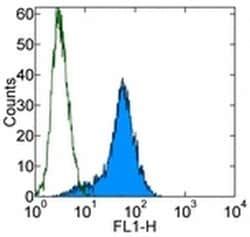
- Applications Tested: This eBioclone 97 antibody has been pre-titrated and tested by flow cytometric analysis of A549 cells
- This can be used at 5 μL (1 μg) per test
- A test is defined as the amount (μg) of antibody that will stain a cell sample in a final volume of 100 μL
- Cell number should be determined empirically but can range from 10^5 to 10^8 cells/test
- Excitation: 488 nm; Emission: 520 nm; Laser: Blue Laser
- Filtration: 0.2 μm post-manufacturing filtered
- MET (cMET) is a receptor-like tyrosine kinase whose dysregulation has been linked to many types of human malignancies
- After activation of the ligand, MET interacts with the PI3-kinase subunit PIK3R1, PLCG1, SRC, GRB2, and STAT3
- There interactions lead to the activation of signaling cascades including RAS-ERK, PI3, kinase-AKT, and PLCgamma-PKC
- MET plays a role in embryonic development including gastrulation, development of muscles and neurons, angiogenesis, and kidney formation
- It also plays a role in adults including wound healing, organ regeneration, and tissue remodeling
- MET has been linked to cancers including gastric, renal, and breast; therefore, making it a target for cancer therapeutics and diagnostic testing.