CD40 Monoclonal Antibody (1C10), PE, eBioscience™, Invitrogen™
Rat Monoclonal Antibody
Manufacturer: Fischer Scientific
The price for this product is unavailable. Please request a quote
Antigen
CD40
Concentration
0.2 mg/mL
Classification
Monoclonal
Form
Liquid
Regulatory Status
RUO
Formulation
PBS with 0.09% sodium azide; pH 7.2
Gene Alias
AI326936; B cell surface antigen CD40; B cell-associated molecule; B-cell surface antigen CD40; Bp50; CD antigen CD40; Cd40; CD40 antigen; CD40 antigen (TNF receptor superfamily member 5); CD40 antigen, TNF receptor superfamily member 5; CD40 molecule; CD40 molecule, TNF receptor superfamily member 5; CD40L receptor; CDw40; GP39; HIGM1; I79_006806; IGM; IMD3; Immunoglobulin M; ImmunoglobulinM; membrane protein CD40; MGC9013; p50; receptor for ligand CD154; sCD40; soluble CD40; T-BAM; T-cell differentiation antigen; Tnfrsf5; TRAP; tumor necrosis factor receptor superfamily member 5; tumor necrosis factor receptor superfamily, member 5
Gene Symbols
CD40
Primary or Secondary
Primary
Content And Storage
4° C, store in dark, DO NOT FREEZE!
Gene
CD40
Clone
1C10
Applications
Flow Cytometry
Conjugate
PE
Host Species
Rat
Target Species
Mouse
Gene Accession No.
P27512
Gene ID (Entrez)
21939
Isotype
IgG2a κ
Purification Method
Affinity chromatography
Product Type
Antibody
Related Products

Description
- Description: The 1C10 monoclonal antibody reacts with mouse CD40, a 45-50 kDa type I transmembrane glycoprotein
- CD40 is a member of the TNFR family and is expressed by mouse B lymphocytes, follicular dendritic cells, thymic epithelium, and a subset of peripheral T cells
- CD40 regulates B cell development/maturation by inducing Ig isotype switching and in combination with other signals such as IL-4, protects B cells from surface Ig-induced apoptosis and promotes proliferation
- Interaction of CD40 with CD154 (gp39), its ligand on T cells, is important in T-B cell crosstalk and plays a role in costimulation and immune regulation
- The monoclonal antibody 1C10 is reported to be agonistic in vitro and in vivo
- Applications Reported: The 1C10 antibody has been reported for use in flow cytometric analysis
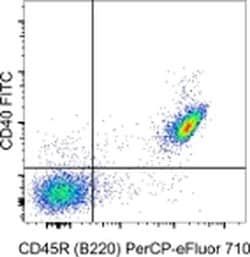
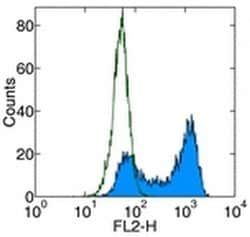
- Applications Tested: The 1C10 antibody has been tested by flow cytometric analysis of mouse splenocytes
- This can be used at less than or equal to 0.5 μg per test
- A test is defined as the amount (μg) of antibody that will stain a cell sample in a final volume of 100 μL
- Cell number should be determined empirically but can range from 10^5 to 10^8 cells/test
- It is recommended that the antibody be carefully titrated for optimal performance in the assay of interest
- Excitation: 488-561 nm; Emission: 578 nm; Laser: Blue Laser, Green Laser, Yellow-Green Laser
- Filtration: 0.2 μm post-manufacturing filtered
- The CD40 antigen is a single chain glycoprotein that is known to be a member of the tumor necrosis factor/nerve growth factor superfamily and shows a significant homology to the Hodgkin's disease associated antigen, CD30
- CD40 is present on all B cells except plasma cells and is also found on some epithelial cells, carcinomas and lymphoid dendritic cells
- CD40 has been found to be essential in mediating a broad variety of immune and inflammatory responses including T cell-dependent immunoglobulin class switching, memory B cell development, and germinal center formation
- AT-hook transcription factor AKNA is reported to coordinately regulate the expression of CD40, which may be important for homotypic cell interactions
- Adaptor protein TNFR2 interacts with CD40 and serves as a mediator of the signal transduction
- The interaction of CD40 and its ligand is found to be necessary for amyloid-beta-induced microglial activation, and thus is thought to be an early event in Alzheimer disease pathogenesis
- Two alternatively spliced transcript variants of CD40 encoding distinct isoforms have been reported
- Diseases associated with CD40 dysfunction include Type 3 Hyper-Igm immunodeficiency and CD40 ligand deficiency.