CD62E (E-selectin) Monoclonal Antibody (P2H3), PE, eBioscience™, Invitrogen™
Mouse Monoclonal Antibody
Manufacturer: Fischer Scientific
The price for this product is unavailable. Please request a quote
Antigen
CD62E (E-selectin)
Concentration
5 μL/Test
Classification
Monoclonal
Form
Liquid
Regulatory Status
RUO
Formulation
PBS with 0.2% BSA and 0.09% sodium azide; pH 7.2
Gene Alias
CD62 antigen-like family member E; CD62E; e selectin; Elam; ELAM1; ELAM-1; endothelial adhesion molecule 1; endothelial leukocyte adhesion molecule; endothelial leukocyte adhesion molecule 1; endothelial leukocyte adhesion molecule I; ESEL; E-selectin; LECAM2; leukocyte endothelial cell adhesion molecule 2; leukocyte-endothelial cell adhesion molecule 2; RP1-117P20.2; SELE; selectin E; selectin E (endothelial adhesion molecule 1); selectin, endothelial cell
Gene Symbols
SELE
Primary or Secondary
Primary
Content And Storage
4° C, store in dark, DO NOT FREEZE!
Gene
SELE
Clone
P2H3
Applications
Flow Cytometry
Conjugate
PE
Host Species
Mouse
Target Species
Human
Gene Accession No.
P16581
Gene ID (Entrez)
6401
Isotype
IgG1
Purification Method
Affinity chromatography
Product Type
Antibody
Related Products


Description
- Description: The P2H3 monoclonal antibody reacts with human CD62E, a 97-115 kDa member of the selectin family
- CD62E, also known as E-selectin or endothelial-leukocyte adhesion molecule-1 (ELAM-1) is an adhesion molecule expressed by endothelial cells upon stimulation with cytokines including TNFalpha and IL-1beta
- Induced expression of CD62E during inflammatory conditions is thought to mediate leukocyte rolling including the initial interaction of neutrophils with endothelium
- The P2H3 monoclonal antibody also inhibits cellular adhesion to cytokine-activated endothelial cells
- Applications Reported: This P2H3 antibody has been reported for use in flow cytometric analysis
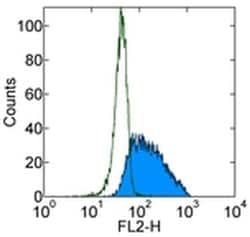
- Applications Tested: This P2H3 antibody has been pre-titrated and tested by flow cytometric analysis of TNF alpha-actiavted Human Umbilical Vein Endothelial Cells (HUVEC)
- This can be used at 5 μL (0.5 μg) per test
- A test is defined as the amount (μg) of antibody that will stain a cell sample in a final volume of 100 μL
- Cell number should be determined empirically but can range from 10^5 to 10^8 cells/test
- Excitation: 488-561 nm; Emission: 578 nm; Laser: Blue Laser, Green Laser, Yellow-Green Laser
- Filtration: 0.2 μm post-manufacturing filtered
- Leukocytes adhere to the blood vessel endothelium during extravasation in postcapillary venules of lymph nodes
- In addition, leukocyte adhesion occurs in the capillaries and small venules at any site in the body after onset of inflammation
- This response is immediate and involves a cascade of adhesion receptors
- At the endothelial surface members of the selectin and immunoglobulin superfamilies participate in this cascade
- Selectins are C-type cell surface lectins that play a role in leukocyte adhesion to the blood vessel wall endothelium
- E-selectin (CD62E) is an endothelial cell specific selectin that is expressed only after activation with proinflammatory cytokines
- In vitro experiments have shown that IL-1, TNFalpha and bacterial wall components like lipopolysaccharides induce the transcription of E-selectin in a NFkB dependent signaling cascade
- E-selectin has been associated with blood vessel endothelium in diverse inflammatory situations.