7068876
CD101 Monoclonal Antibody (Moushi101), PE, eBioscience™, Invitrogen™
Rat Monoclonal Antibody
Manufacturer: Fischer Scientific
The price for this product is unavailable. Please request a quote
Antigen
CD101
Concentration
0.2 mg/mL
Classification
Monoclonal
Form
Liquid
Regulatory Status
RUO
Formulation
PBS with 0.09% sodium azide; pH 7.2
Gene Alias
Cd101; CD101 antigen; CD101 molecule; cell surface glycoprotein V7; EWI immunoglobulin subfamily member EWI-101; EWI101; EWI-101; Glu-Trp-Ile EWI motif-containing protein 101; Gm1016; Gm734; IGSF2; Immunoglobulin superfamily member 2; immunoglobulin superfamily, member 2; leukocyte surface protein; RP11-27K13.2; V7
Gene Symbols
CD101
Primary or Secondary
Primary
Content And Storage
4° C, store in dark, DO NOT FREEZE!
Gene
CD101
Clone
Moushi101
Applications
Flow Cytometry
Conjugate
PE
Host Species
Rat
Target Species
Mouse
Gene Accession No.
A8E0Y8
Gene ID (Entrez)
630146
Isotype
IgG2a κ
Purification Method
Affinity chromatography
Product Type
Antibody
Related Products


Description
- Description: The monoclonal antibody moushi101 recognizes mouse CD101, also known as IGSF2 and V7 (7 IgV domains)
- CD101 is a transmembrane glycoprotein containing 7 Ig-like IgV domains and a short cytoplasmic tail with several phosphorylation sites
- Cross-linking CD101 can antagonize TCR/CD3-mediated lymphocyte activation
- CD101 is expressed on monocytes, granulocytes, dendritic cells, Langerhans cells and activated T cells
- In addition, CD101 is found on a subset of CD25+Foxp3+ T regulatory cells that showed higher suppressive properties in vitro and in vivo
- Applications Reported: This Moushi101 antibody has been reported for use in flow cytometric analysis
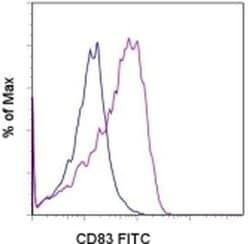
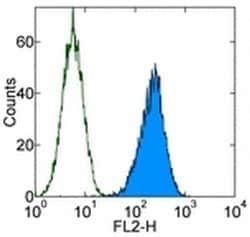
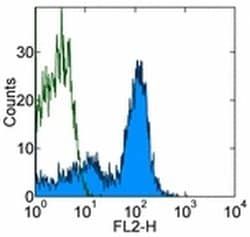
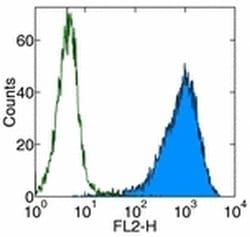
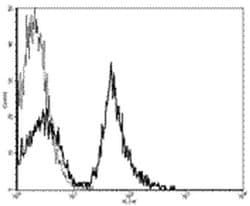
- Applications Tested: This Moushi101 antibody has been tested by flow cytometric analysis of mouse splenocytes
- This can be used at less than or equal to 0.25 μg per test
- A test is defined as the amount (μg) of antibody that will stain a cell sample in a final volume of 100 μL
- Cell number should be determined empirically but can range from 10^5 to 10^8 cells/test
- It is recommended that the antibody be carefully titrated for optimal performance in the assay of interest
- Excitation: 488-561 nm; Emission: 578 nm; Laser: Blue Laser, Green Laser, Yellow-Green Laser
- Filtration: 0.2 μm post-manufacturing filtered
- CD101 also known as V7 antigen, a member of the Ig superfamily
- CD101 is a disulfide linked homodimer of unknown function
- Expression of CD101 is found on monocytes, granulocytes and dendritic cells (Langerhan-like cells HLA-DR, CD1a, CD1c)
- In addition expression on T lymphocytes is important for cell activation
- CD101+ CD28+ cells are very responsive to CD28 signaling
- In combination with anti-CD28 or suboptimal levels of anti-CD3, anti-CD101 can increase proliferation thereby suggesting an activating role
- The monoclonal antibody BB27 has been shown to inhibit the T cell reactivity in allogeneic and antigen-specific mixed DC-T cell cultures
- Recently it has been demonstrated that mouse CD101 is found on a subpopulation of regulatory T cells (CD4, CD25, Foxp3 positive) that have high suppressor activity
- Expression of CD101 on human PBMCs shows staining of about 30% of the Foxp3 positive cells
- Studies have not confirmed higher suppressor activity in the human CD101 population.